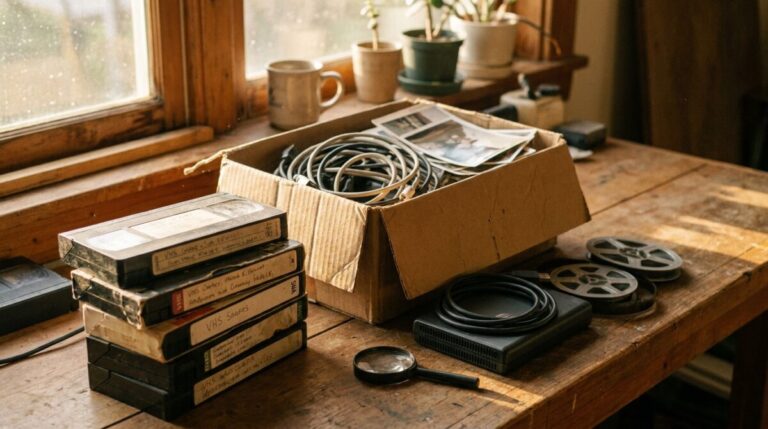
A 400 ft 16mm reel costs $112 at the $0.28 per foot Gold HD special, or $160 at the regular $0.40 rate, and a 1200 ft reel runs $336 to $480. Who should touch it: a lab that scans the reel in the same building you hand it to, frame by frame, with no projector, no hot bulb and no sprockets tugging at brittle perforations. When you search “transfer 16mm film to digital near me,” the deciding factor is not mileage. A storefront two miles away that mails your only copies to a subcontractor is farther from your film than an in-house lab across the country. Because 16mm is priced per foot, you pay only for the footage actually transferred.
- “Near me” should mean the reel never leaves the building it is scanned in.
- 16mm is priced per foot, so a 400 ft reel and a 1200 ft reel are very different jobs.
- The cleaner a lab uses tells you more than any adjective on its homepage.
- Frame-by-frame capture, no hot bulb, no sprockets – the shortcut everyone else takes is the one that scratches film.
- Film and magnetic tape both degrade with time. Earlier digitization preserves more.
The question that separates real labs from mailrooms
Most people picture a counter down the street and stop there. Ask the follow-up instead: who scans the film, and in what room? Many retail counters are collection points that box your reels and forward them.
Every hand-off is another chance for an irreplaceable reel to be misrouted. Ask plainly, “Is the scanner in this building?” If the answer wanders into “our partners” or “our facility,” keep asking until you get an address.
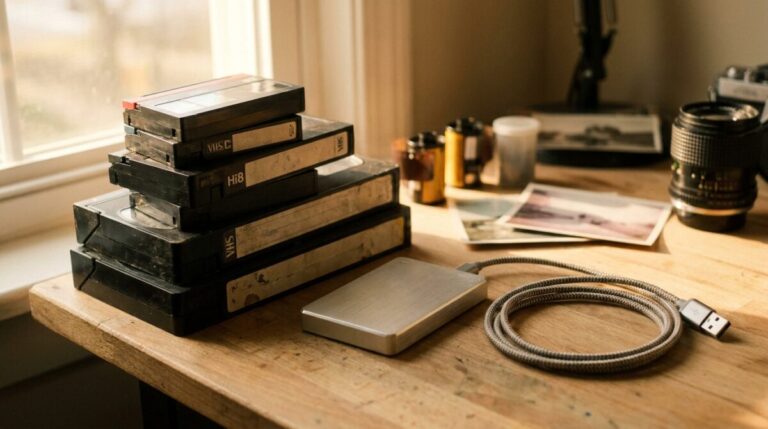
The same logic covers the tapes in the same closet. If you also plan to convert videotapes to digital and transfer video tapes to DVD or an external hard drive, one in-house lab means one pickup, one return, and one chain of custody instead of three.
What 16mm is, in plain language
16mm film is twice the width of standard 8mm, which gives it roughly four times the image area per frame. It was the format of school films, church projects, industrial reels and serious home moviemakers.
That extra area is why 16mm rewards a higher scan tier in a way small 8mm sometimes does not. 16mm reels also run longer, and because pricing is per foot, footage matters far more than how many cans are in the box.
Some 16mm carries a magnetic or optical soundtrack along the edge. If your reels have sound, mention it when you request a quote, because sound reels are handled differently from silent ones.
What a 400 ft and a 1200 ft reel actually cost
16mm reel sizes are standardized, which makes budgeting easy once you know the per-foot rate. A 400 ft reel and a 1200 ft reel are the two you will meet most often.
| Reel size | At $0.28/ft (Gold HD special) | At $0.40/ft (regular) | Notes |
|---|---|---|---|
| 400 ft 16mm | $112 | $160 | Common mid-size reel |
| 1200 ft 16mm | $336 | $480 | Large reel, often spliced from several shorter ones |
You pay only for the footage we actually transfer, so a half-wound 400 ft reel is never billed as a full one. Platinum and Professional 2K cost more per foot, and many 16mm clients choose one because 16mm holds more detail. Our film to digital transfer cost breakdown carries the full rate card for every format, a worked example, and the footage math; our answers on how much it costs to convert 16mm and whether we charge by the reel or by the foot go deeper on those two questions.
The one step that quietly ruins reels
Running old film through a projector “just to see what’s on it” is the most common mistake we see. Projector bulbs dry the film with heat, and the transport rubs the surface and leaves scratches. A single screening does not undo itself.
Storage does the slow version of the same damage. Humidity and temperature have to stay in a narrow band or film fades and turns brittle, which is why a reel that looked fine in 1998 can crack on the first bend today.
Every projector pass costs picture quality no scan can bring back. If you are weighing home methods first, our walkthrough of DIY 8mm film to digital and the three methods people actually try shows exactly where each shortcut breaks down, and our guide to the one step that ruins reels and how the job should be done walks through the process a proper lab follows instead.
How the transfer is actually done here
Cleaning comes first. Reconditioning re-lubricates brittle film, lifts an oxidation layer and removes dust, so the scanner reads the picture instead of decades of grit. We use the same film cleaners the Hollywood studios use.
Watch for anyone saving money with isopropyl alcohol. It is a drying agent, and on already-fragile stock it can do real harm. If a lab will not name what it cleans with, that is your answer.
Then the film runs through a system with no hot bulb and no sprockets pulling at the perforations. Each frame is captured individually, straight into the computer, without anything touching the image – a frame accurate, fully digital transfer in full 1080p. It is the same process the Academy of Motion Pictures uses on its legacy archives, including original prints from Alfred Hitchcock and others.
Touchless, frame by frame, cool light
Touchless matters because the emulsion carries the picture, and anything that contacts it can abrade it. Frame-by-frame matters because it yields one clean digital frame per film frame instead of a camera guessing at a flickering screen. Cool capture matters because heat is what dried your film in the first place.
Resolution, grain and color
Scanning is done at Full HD or 2K, with grain reduction and accurate color correction available so the result looks true to the original rather than artificially scrubbed, which is what it really takes to convert film to digital properly. On 16mm the extra resolution is not marketing – the stock genuinely holds it.
Details we cannot verify from our published specs, such as exact scanner model numbers, delivered file container and codec, how a given lab handles 18 fps versus 24 fps, turnaround in business days, and shipping insurance limits, vary by lab and by job. Ask for each of those in writing. Any lab worth using will answer without hedging, and ours will put its answers on your quote. If you are comparing providers, the four questions that decide which digitizing service to use cover resolution, restoration, liability for a lost original, and the all-in price per item.
If you are outside driving distance
Plenty of people searching “near me” have no in-house lab nearby. Shipping to a lab that does the work itself still beats a local counter that forwards your reels to a stranger. Vet it the same way, then pack carefully, and read what you should know before you ship your only copies first.
- Get the physical address where scanning happens, not a mailing address.
- Wind each reel fully and store it flat in its can or a rigid box, not loose in a shopping bag.
- Pad every side so cans cannot slide, and use a sturdy outer box with the inner boxes not touching the walls.
- Number the reels and keep your own list before they leave your hands.
- Insure the shipment for the replacement value you and the lab agree on in writing, and confirm the lab’s own insurance terms before shipping.
- Require tracking and a signature on delivery both directions.
Red-flag phrases that usually mean a middleman: “our partner lab,” “our production facility” with no address, “we ship to our processing center,” and a quote given in reels when 16mm is priced per foot. None of those are crimes, but each one means an extra hand-off you did not agree to.
Two ways this job gets done
| Approach | How the image is captured | Risk to the original | Typical result |
|---|---|---|---|
| Projector and camcorder | Camera films a screen | Heat drying, surface scratches | Flicker, hot spots, soft image |
| Frame-by-frame lab scan | Each frame captured directly to computer, no hot bulb or sprockets | Film cleaned and re-lubricated first, image untouched | Frame accurate, full 1080p |
58 customer reviews
“Updated February 2, 2025 Free estimate See what your memories will cost Itemized down to the penny, and it updates instantly as you go. No obligation. Or call (…”
“Updated February 2, 2025 Free estimate See what your memories will cost Itemized down to the penny, and it updates instantly as you go. No obligation. Or call (…” - Excellent Product Outcome
Rated 4.9/5 across 225 Google reviews
- Transferring film and tape in our own lab since 2001
- Your originals are handled in-house and returned with every order
- Frame-by-frame film scanning with grain reduction and color correction
- Family owned and operated since 2001
- Nearly 20,000 satisfied customers
Twenty-five years doing this in our own lab, nearly 20,000 customers since 2001, and a 4.9 out of 5 Google rating across 190 reviews. The reels people regret are almost never the ones they brought in too early.
If you are in Southern California
We are an Orange County company located in Orange, and we take drop-offs from across the region, including film transfer for Los Angeles, Irvine, Costa Mesa and San Diego. Everything is scanned here.
Do the film and the tapes together
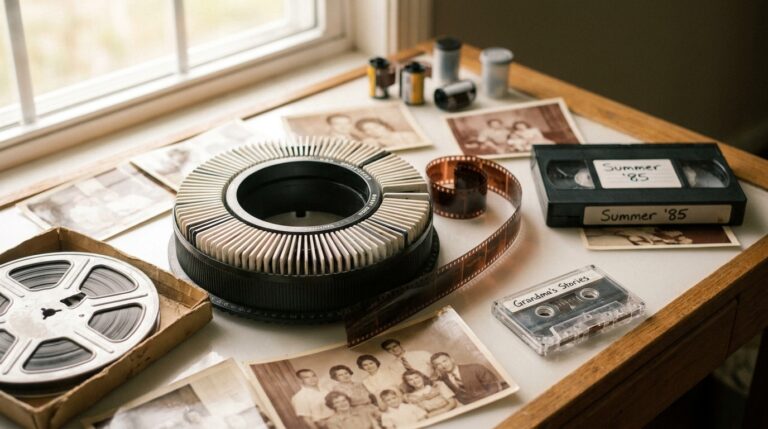
Film fades and grows brittle. Magnetic tape sheds oxide and loses signal on its own schedule. Both are getting quietly worse in the same closet, and the earlier they are digitized the more of the original survives into the file.
FAQ
How do I find a place to transfer 16mm film to digital near me?
Search locally, then screen on one question: is the scanner in that building? Ask whether film is cleaned and reconditioned first, what cleaner is used, whether capture is frame by frame with no projector or hot bulb, and what resolution you receive. A lab that answers crisply is worth a longer drive.
How much does it cost to convert 16mm film to digital?
From $0.28 per foot at the Gold HD special, regularly $0.40. That works out to $112 for a 400 ft reel at the special rate, or $336 for a 1200 ft reel. Platinum and Professional 2K cost more per foot, and many 16mm clients choose them because the format holds more detail. You pay only for footage actually transferred.
Is it safe to ship 16mm reels instead of dropping them off?
Yes, if you pack and insure them properly. Wind each reel, keep it in a can or rigid box, pad all sides inside a sturdy outer carton, number your reels, use tracking and signature both directions, and insure the shipment for a value you and the lab agree on in writing. Confirm the lab’s own insurance terms first.
Can I just project my 16mm film and record the screen?
You can, but it costs you the film. Projector bulbs dry the stock with heat and the transport rubs the surface, causing scratches, and that damage is irreversible. A recording of a screen also inherits flicker, hot spots and softness a direct frame-by-frame scan never introduces.
Do I need to know my footage before getting a quote?
No. Send or bring the reels as they are. Since 16mm is priced by the foot and you are billed only for footage actually transferred, the number is settled from the film itself, not from a guess.
Should I do my videotapes at the same time?
Usually, yes. Film and magnetic tape both degrade over time, and handling them in one batch means one hand-off instead of several. Our page on how long VHS tapes last before they degrade explains what is happening inside those cassettes.
A simple next step
You do not have to pick a tier today. Count your 16mm reels, note the footage marked on each can and whether any have a soundtrack, and ask for a free quote. The reels will keep for a conversation. They will not keep for another decade.
Reviewed by Scott Foster, Founder of Legacy Digital Productions, Orange, CA - transferring film, tape, slides, photos and audio in-house since 2001 - last updated August 14, 2026.
Sources for this article
- 16mm from $0.28 per foot at Gold HD special, regularly $0.40; Platinum and Professional 2K tiers; pay only for footage actually transferred (FAQ: How much does it cost to convert 1
- 400 ft x $0.28 = $112; 400 ft x $0.40 = $160; 1200 ft x $0.28 = $336; 1200 ft x $0.40 = $480 (arithmetic on provided rates only)
- Cleaning re-lubricates brittle film, removes oxidation layer and dust; same film cleaners as Hollywood studios; isopropyl alcohol is a drying agent that can damage film (Orange/Irv
- No hot bulb, no sprockets, each frame captured individually straight into computer without touching the image; frame accurate, fully digital, full 1080p (Orange/Irvine posts)
- Same process used by the Academy of Motion Pictures on legacy archives including Alfred Hitchcock prints (Orange/Irvine posts)
- Full HD or 2K scanning with grain reduction and accurate color correction (Special B, home page post)
- Projector bulbs dry film with heat and projectors rub film causing scratches; humidity and temperature must be maintained or film fades and becomes brittle (Special B)
- All 8mm and 16mm film reels fade as they age (Orange post)
Facts drawn from this site's own documented knowledge and first-hand experience.