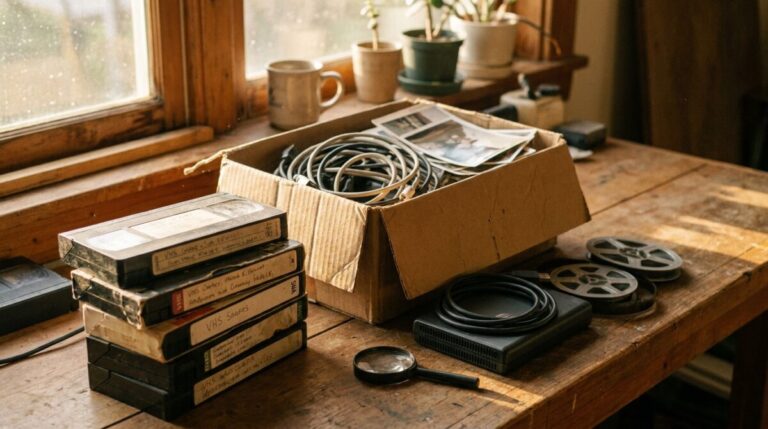
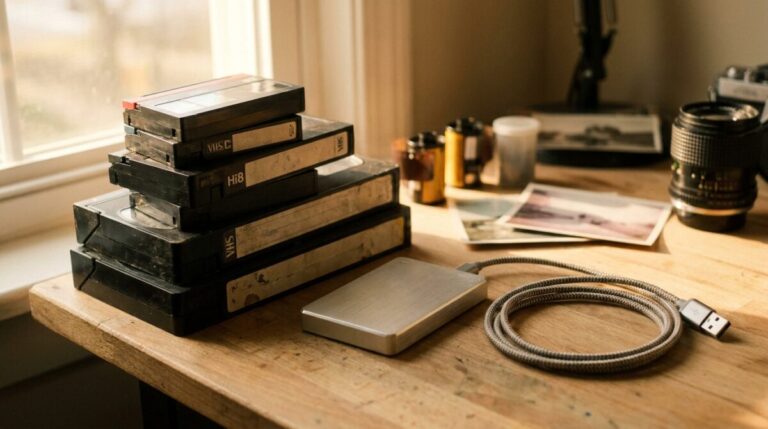
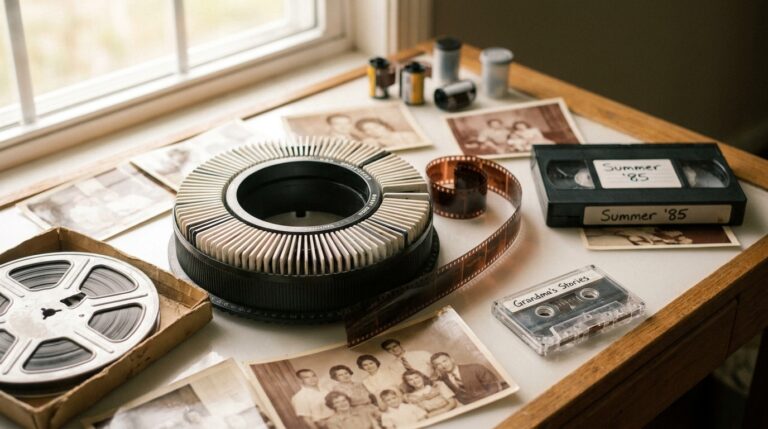
VHS tapes do not expire on a set date, but they do go bad: the tape inside a VHS cartridge begins to degrade after about 15 years. There is no printed expiration, just a slow decline that starts around that 15 year mark and shows up as color shifting, softness, dropouts, and sound that wavers. Since the last consumer VHS camcorders were sold decades ago, essentially every family tape on a shelf today is already past it. So the practical answer to how long VHS tapes last is the one we give customers: they are degrading right now, and every year you wait means a slightly worse copy when you finally digitize.
A VHS tape starts losing picture and color about 15 years after it was recorded, which means essentially every home video tape still on a shelf today is already past that point.
What “15 years” actually means
Most people hear a lifespan number and picture an expiration date, a day when the tape simply stops working. That is the belief worth correcting. Magnetic tape does not fail all at once. It fades. The binder that holds the magnetic particles to the plastic backing loosens, colors drift, and the recorded signal gets weaker and noisier. You may play a 1988 birthday tape and think it looks “fine,” but what you are seeing is a version that has already lost information you will never get back. Search how long do VHS tapes last on Reddit and you will find the same argument playing out in thread after thread, with one person insisting their old tapes look perfect and another pointing out that a picture can look acceptable and still be a faded copy of what was recorded.
The tape within VHS cartridges begins to degrade after just 15 years, which means nearly every home video tape in existence is already past that threshold.
Two ways tapes lose quality
Playing them
Every pass through a VCR wears the tape. Video tapes are degrading and losing quality each time they are played. A stuck or dirty machine can crease or eat a tape in seconds, and a one-of-a-kind wedding reel does not get a second take.
Sitting still
This one surprises people. Tapes also become more distorted just sitting in their box or on a shelf. Analog media is prone to deterioration, discoloration, and destruction from natural disasters like humidity, flooding, and fires. A hot attic or a damp basement is a slow-motion disaster for a shoebox of tapes. It also matters that new blank stock is not being made the way it once was, so the question of whether VHS tapes are still made is mostly academic: the tapes you own are the only copies of your footage that exist.
How to tell your tapes are going
Watch for color that looks washed out or tinted, snow and horizontal streaks, audio that warbles, picture that rolls or tears, or a tape that squeaks and drags in the machine. If you see mold, a crushed shell, or loose tape spilling from the cassette, stop playing it. Assess for physical damage such as scratches, tears, or other wear, and if you are unsure how to handle a damaged tape, get help from a professional service rather than risking it in a home VCR.
Does digitizing stop the clock?
It stops the clock on the copy. A digital file will not fade, discolor, or mildew. Transferring your tapes preserves not just the content but the color and overall quality as it exists today, which is why doing it sooner produces a better file than doing it in five years. The tape itself keeps aging in the box, but the memory is safe.
What about film reels and slides?
Film has its own version of the same problem. Use, time and the elements are the arch enemies of all film media. Old projectors use hot bulbs that dry the reels, and the projector makes contact with the picture area, scratching the surface and causing permanent damage. Even in storage, film fades and becomes brittle when the air is too dry, too humid, or the temperature is not right. The longer you wait, the worse it gets, and at some point converting it becomes more difficult, more expensive, or even impossible. If your closet holds both tapes and reels, our 8mm and 16mm film transfer service handles the film side of the pile.
Do it yourself or send it out?
Home conversion is real and workable: buy an A/V-to-USB adapter cable, plug it into a USB 2.0 port, connect your analog video source with the included RCA composite or S-video cables, and use the bundled software to capture in real time. Real time means a two hour tape takes two hours. It also means you need a working VCR you trust. If discs are your preferred output, our guide to converting VHS to DVD explains which discs last and which fail within a few years. Our full walkthrough of both paths is in Convert Video Tapes to Digital: Your Best Options, and it covers equipment, formats, and how to organize and label the finished files.
Professional transfer makes the most sense when tapes are damaged, when there are more of them than you have evenings, or when the footage is truly irreplaceable. Our videotape to digital service covers every commercial format and charges per tape, so you pay only for the ones you actually have.
FAQ
How long do VHS tapes last before they go bad?
The tape inside a VHS cartridge begins to degrade after about 15 years. Degradation is gradual rather than sudden, showing up as lost video quality and shifted color long before a tape becomes unplayable.
Do VHS tapes degrade if you never play them?
Yes. Tapes become more distorted sitting in their box or on a shelf. Humidity, heat, and flooding or fire risk all threaten stored tapes, so leaving them untouched does not protect them.
Is it too late to save a tape from the 1980s?
Usually not. Tapes from that era have degraded, but most still play and transfer. Quality will be lower than it was when new, which is exactly why waiting longer is the wrong move.
Can a broken or moldy VHS tape still be transferred?
Often it can. VHS tapes can be restored to playable condition more often than people expect. Check for scratches, tears, and other physical damage first, and do not force a damaged tape into a VCR. If you are unsure, hand it to a professional video conversion service that can open, clean, and repair the cassette before transfer. What cannot be restored is signal that has already faded off the tape, so repair is about getting a damaged cassette through a machine safely, not about rebuilding lost picture.
Will digitizing make my old tape look better?
Digitizing preserves the color and overall quality that is on the tape today and prevents further loss. It cannot restore detail that has already faded, which is the case for earlier conversion.
A simple next step
You do not have to decide about the whole shoebox today. Pull out the three tapes you would grieve most, check the labels, and get a sense of what you are dealing with. When you are ready, you can request a free estimate or a simple quote with no obligation, and we will tell you plainly what your tapes need. There is no rush from us, only from the tape.
Reviewed by Scott Foster, Founder of Legacy Digital Productions, Orange, CA - transferring film, tape, slides, photos and audio in-house since 2001 - last updated September 7, 2026.
Sources for this article
- VHS tape within cartridges begins to degrade after just 15 years (POST: Convert Video Tapes to Digital in 2023)
- Degradation leads to loss in video quality, making it harder to relive memories (same post)
- Analog media are prone to deterioration, discoloration, and destruction from natural disasters including humidity, flooding, fires (same post)
- Digital conversion preserves color and overall quality of footage (same post)
- Video tapes degrade and lose quality each time played and also become more distorted sitting in the box or on a shelf (POST: Film Transfer & Media Conversion Special)
- Film degrades from use, time and elements; projectors use hot bulbs and contact the picture area causing scratches; film fades and becomes brittle; waiting makes conversion harder,
- DIY conversion uses an A/V-to-USB adapter into a USB 2.0 port with RCA composite or S-video cables and real-time software transfer (same post)
- Damaged tapes: assess for scratches and tears, seek professional help if unsure (same post)
Facts drawn from this site's own documented knowledge and first-hand experience.