We are an independent lab in Orange, California that competes with the mail-in box services named below, so read our numbers with that in mind.
Film to digital transfer is priced by the foot, not by the reel. Our silent scans run $0.28 to $0.45 per foot at current special rates, which is about $14.00 to $22.50 for a standard 3 inch, 50 foot reel. A $50.00 service minimum applies, and reels up to 50 feet carry a $5.00 technical surcharge each. So the first thing to do is not shop, it is measure: count your reels by diameter and add up the footage.
- A 3″ reel holds about 50 ft. A 7″ reel holds about 400 ft.
- Three tiers, silent special rates: Gold HD $0.28/ft, Platinum HD $0.35/ft, Professional 2K $0.45/ft.
- Sound film costs $0.10 more per foot at every tier.
- Expected production cycle is about 6 weeks, an estimate rather than a hard date.
- All work is in-house in Orange, CA. Nothing is subcontracted or sent overseas.
Why per-reel pricing is the wrong unit
Most people picture a box of reels and assume the bill is a flat price times the count. Per-reel pricing works that way by design: the unit is the reel, not the footage on it. A 3 inch reel holds about 50 feet and a 7 inch reel about 400 feet, so two reels that cost the same in a bundle can be eight times apart in the film they actually contain. That is why we quote by footage. If your reels are 16mm rather than 8mm or Super 8, our guide to what a 400 ft 16mm reel really costs and who should handle it goes deeper on that format.
Footage is the honest unit because footage is the work. Our estimator assumes full reels, and reels are rarely full. Blank, unrunnable and empty footage is never charged, so send 20 half-full reels and you pay for about 10 reels’ worth of film. Most clients pay a little under their quote, not over.
Measure your footage first
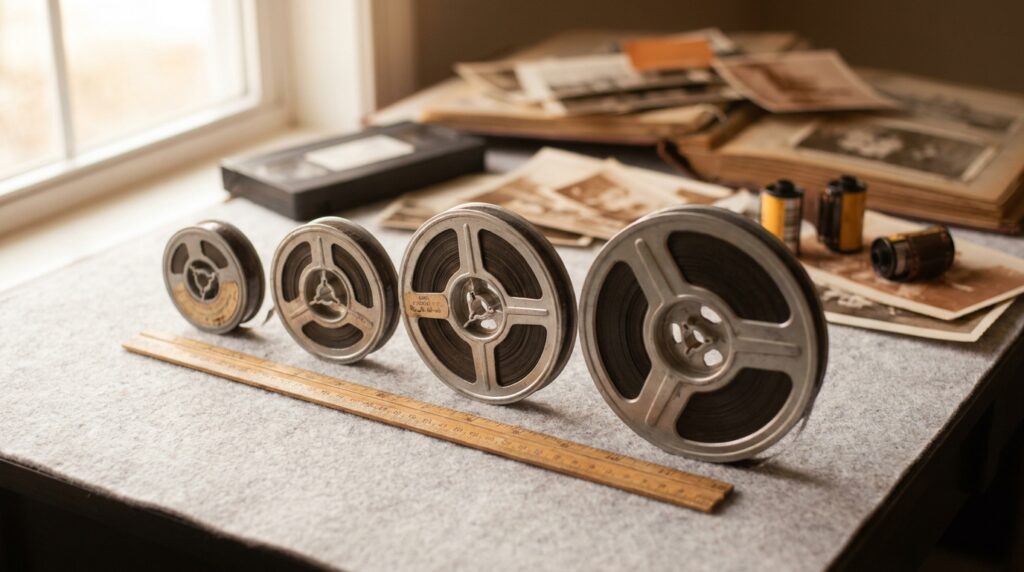
Reel diameter is the shortcut, and it is accurate enough to price a job over the phone.
| Reel | Approx. footage | Approx. runtime |
|---|---|---|
| 3″ reel | 50 ft | 3-4 min |
| 5″ reel | 200 ft | 14-18 min |
| 6″ reel | 300 ft | 21-24 min |
| 7″ reel | 400 ft | 28-33 min |
| 9 1/4″ reel | 600 ft | 36 min |
| 12″ reel | 1,200 ft | 72 min |
Film runs at roughly 3.6 seconds of screen time per foot. A shoebox of small reels is usually less running time than people expect, which is the rare piece of good news in this business.
What the tiers actually buy you
Gold HD, Platinum HD, Professional 2K
| Tier | What it is | Silent (special) | Sound (special) | Storage per ft |
|---|---|---|---|---|
| Gold HD | HD 1080p frame-by-frame scan | $0.28 | $0.38 | 31.75 MB |
| Platinum HD | HD plus full color correction and grain reduction | $0.35 | $0.45 | 31.75 MB |
| Professional 2K | 2K scan with full color correction and grain reduction | $0.45 | $0.55 | 50 MB |
Regular list rates are higher: $0.40, $0.50 and $0.65 per foot silent. Platinum HD is the default because color correction is where most of the visible improvement lives on faded home movie stock. The jump to 2K buys resolution, and its value depends on how sharp the original camera work was.
One distinction to hold onto whenever a service offers “AI enhancement” instead of a better scan: AI upscaling guesses at detail, while a better scan records detail that was always there. If a reel is digitized once at low resolution, upscaling that file is guesswork unless the original film is scanned again.
A worked example: 12 reels and 6 tapes
Twelve Super 8 reels, all 3 inch (600 ft total), silent, plus six VHS tapes under two hours each. At Platinum HD that is 600 ft at $0.35, so $210.00 of film, plus twelve $5.00 small-reel surcharges ($60.00), plus six tapes at $19.95 ($119.70). Conversion services total $389.70, which clears the $250.00 threshold for the current 10% coupon on services. Surcharges are excluded from the discount. A drive is separate and taxable. The conversion labor is not.
The same 600 ft run through the named alternatives
Legacybox, Southtree and Kodak Digitizing sell film in per-reel bundles rather than per foot, and as of August 2026 their published spec for film is 480p standard definition, one-to-one, with no color correction. That is the comparison that matters more than the total: resolution is the one thing you cannot add later, so a 480p scan is the picture you keep unless the film is scanned again. Prices and bundle contents change often, so check their current published rate and what resolution it buys on the day you compare.
Where a bundle genuinely wins: twelve small 50 ft reels are twelve line items for them and twelve $5.00 surcharges for us, so on a pile of tiny reels a bundle can come out cheaper. Where it loses: a single 400 ft reel is one bundle unit at their price and 400 ft at ours, and the footage math usually flips in our favor. Run both. Our page on how to choose a film to digital transfer service and what should move the price is the head-to-head if you want the long version, and our iMemories vs Legacybox comparison covers how each service handles shipping, tracking, and the return of your originals.
A checkable proxy you can verify yourself: file size. Our HD film scans run about 31.75 MB per foot and 2K about 50 MB per foot, and a two-hour videotape comes back around 12.5 GB. If a service returns a two-hour tape as a 1 to 2 GB file, that is a compression decision, and the detail it discards is not recoverable from the file they send back.
What happens to your film here
Cleaning and lubrication come first, with the archival solution studios use on their own prints, never isopropyl alcohol, which dries film and damages it over time. Splices get repaired as needed.
Then the scan. Frame-by-frame capture is touchless and sprocket-free under cold LED light, with no projector, no gears in the picture area and no hot bulb – gentle enough that we have run film from 1924. That stage alone takes two to three times the running length of your film, which is precisely why it costs more than a camera pointed at a screen. Afterward a technician adjusts color, contrast, brightness and exposure scene by scene.
One family’s film is in the studio area at a time, and no reel leaves the building. The step-by-step version lives in what actually happens to your reels.
Do not project old film to preview it first. That single step is where most of the damage we see originates: a dry, brittle reel meeting a hot projector gate. If you want to know what is on a reel, hold a few feet up to a window. That is enough.
When the answer is “we could not fully save it”
Film stored through heat cycles in a garage or attic can shrink, curl and develop vinegar syndrome, and no scanner recovers emulsion that has lifted off the base. A shrunken reel will not track evenly through any gate, and the picture that comes back is the picture that survived. A frame-by-frame scan still captures more than a projector transfer would, because the gate is gentler and the light is cold, but we say so before the invoice, not after.
That is also the honest argument for going sooner. Film and magnetic tape both degrade on a clock that does not stop, and videotape gets worse sitting in its box, not only when played. Earlier digitization preserves more picture, permanently.
Your pre-shipping checklist
Price your reels before you ship
Do this in one sitting, on the floor, with the box open.
- Sort the reels by diameter and count each pile: 3″, 5″, 6″, 7″, larger.
- Multiply each pile by the footage in the table above and add it up.
- Note which reels are sound and which are silent. Sound adds $0.10 per foot at every tier.
- Flag anything 600 ft or larger, plus any slide carousels. Neither is kit-shippable.
- Add $5.00 for every reel of 50 ft or less, then check whether your total clears $250.00 for the 10% services coupon.
- Ask any lab three questions: what scan resolution do you publish, does my film ever leave your building, and do I get my originals back.
Getting it to us, and paying for it
Three ways in: walk in or drop off within about 75 miles of the Orange, CA studio, ship it yourself, or order a prepaid shipping kit at $35.00 ($45.00 for large orders, meaning 100+ tapes or 7,500+ ft of film). A kit holds up to 15,000 ft of film per order. Orders of $100.00 or more default to shipping it yourself. Return shipping is billed at the UPS carrier rate on the final invoice and is never taxed.
Payment runs in three cumulative stages: $50.00 at checkout reserves your place in line, arrival of your media brings you to 50% of the pre-tax order, and the balance is due at completion on reconciled actual counts. Converting media you already own is a non-taxable service in California. Tangible output like drives and DVDs is taxable at the 7.75% Orange base rate, or the destination district rate on shipped orders. DVD output is $15.00 per disc and holds up to 1,250 ft of film, which is why most families with a full box choose a drive.
Photos, slides and negatives can ride along in the same order. If albums or a carousel are mixed in with the reels, our photo scanning service page covers how prints and albums are priced and delivered.
What changes after you do this
The box stops being a risk and becomes a file your whole family can open. Across nearly 20,000 customers since 2001, and 191 Google reviews averaging 4.9 out of 5, the sentence we hear most is some version of “I had not seen her move in forty years.”
When you are ready, get a free itemized estimate or call and read your reel sizes off over the phone. Nothing ships until you have the number in writing. The reels can wait in the closet while you think it over, just not another decade.
FAQ
What file format will my film come back as?
Digital video files on the medium you choose: hard drive, DVD, Blu-ray, USB flash drive or SD card. The system sizes your library from the per-foot storage figures and recommends the smallest drive that fits with 10% headroom.
How long does film to digital transfer take?
Our expected production cycle is about 6 weeks. That is an anticipated window rather than a hard date, because queue depth and reel condition both vary.
Can I use my own hard drive instead of buying one?
Yes. Copying to a customer-supplied drive is $10.00 per copy. You own your originals throughout, and any drive we sell you is yours to keep.
What if my order is small, like two reels?
A $50.00 service minimum applies. If your conversion services total less, a “Minimum order adjustment” line brings the invoice up to it. Output media like drives does not count toward the minimum.
Do coupons apply to drives and shipping?
No. The current 10% coupon applies to orders with $250.00 or more of conversion services, and it covers scanning and conversion services only, never drives or shipping. Auto-issued single-use codes expire after 30 days.
Can you transfer 16mm and sound film too?
Yes. We handle 8mm, Super 8, 16mm and Technicolor reel-to-reel film. Sound reels are priced $0.10 higher per foot at each tier, and larger reels of 600 ft or more need to be dropped off or shipped directly rather than sent in a kit.
Reviewed by Scott Foster, Founder of Legacy Digital Productions, Orange, CA - transferring film, tape, slides, photos and audio in-house since 2001 - last updated October 17, 2026.
Sources for this article
- Film per-foot tiers and silent/sound special rates from the film transfer table
- Reel size to footage/runtime table; 3.6 seconds per foot
- $5.00 small reel surcharge, excluded from coupons
- $50.00 service minimum and Minimum order adjustment line
- 10% coupon at $250.00+ of conversion services, 30-day expiry, services only
- Video tape $19.95 special, up to 2 hours, ~12.5 GB per 2-hour tape
- Storage 31.75 MB/ft HD, 50 MB/ft 2K
- Shipping kit $35.00 / $45.00 large orders; 15,000 ft cap; 600+ ft reels and carousels not kit-shippable; $100+ default self-ship
Facts drawn from this site's own documented knowledge and first-hand experience.