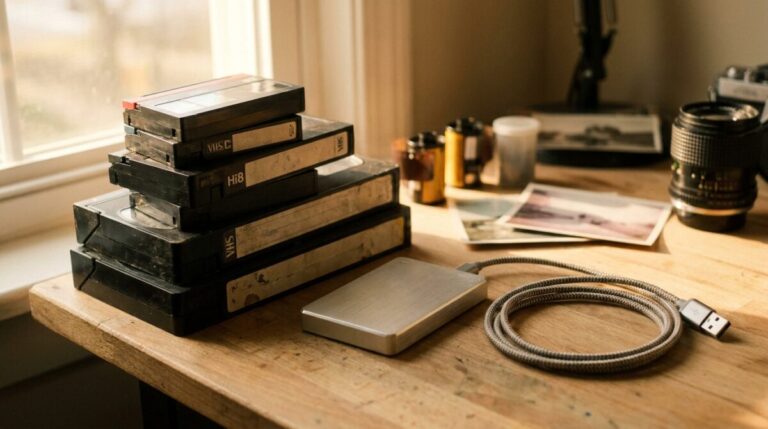
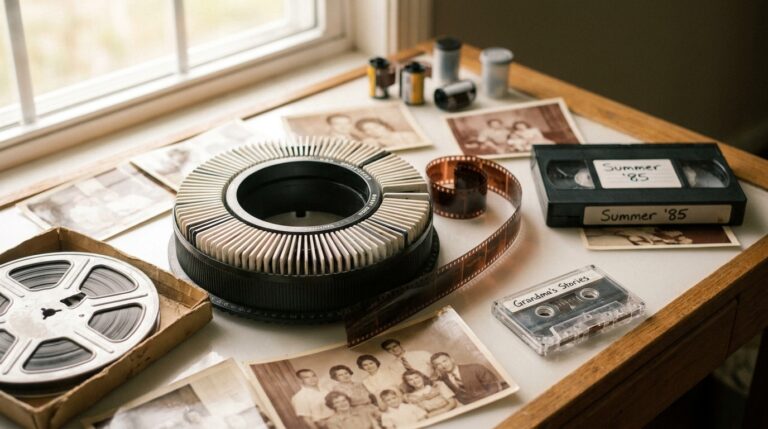
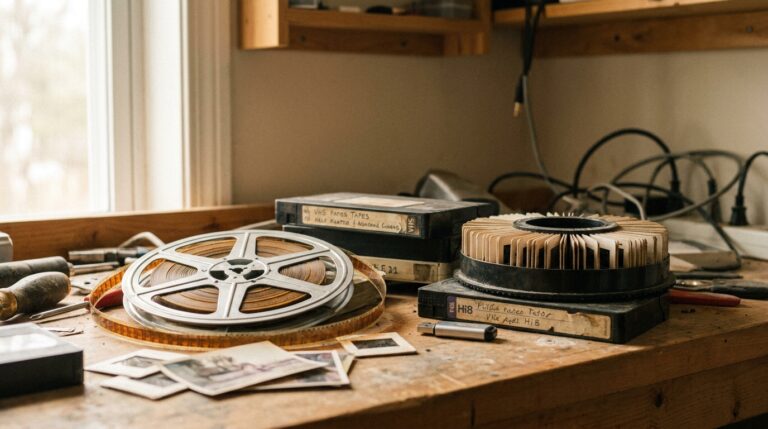
In 2026 you have three realistic ways to convert video tapes to digital: capture them yourself in real time with a working deck and a USB capture device, mail them to a box service that charges a flat fee per box, or use a lab that charges per tape and does the work in-house. The one factor that should drive your choice is not price, it is real time: there is no fast-forward in tape capture, so a 2-hour tape takes 2 hours on anyone’s machine. Thirty tapes is sixty hours of somebody’s life. That is the whole decision.
- Capture is real time. A 2-hour tape takes 2 hours, DIY or lab, and no service can shortcut it.
- We charge per tape up to 2 hours; a 4-hour tape counts as 2 units, a 6-hour tape as 3.
- A 2-hour tape lands at roughly 12.5 GB, so 20 tapes is around 250 GB.
- VHS tape begins to degrade after about 15 years. Even the newest home tapes are well past that.
- Every order is handled in-house in Orange, California. Nothing is subcontracted or sent overseas.
Why you can trust the answers on this page
- 25 years transferring film and tape in our own lab, nearly 20,000 customers since 2001.
- 4.9 out of 5 across 194 Google reviews – see where these counts come from and how to check them, last checked September 2026.
- No subcontracting. Your tapes stay in Orange, CA, from intake to return.
- Local drop-off within about 75 miles of the studio, or ship them yourself, or order a prepaid kit.
58 customer reviews
“Updated February 2, 2025 Free estimate See what your memories will cost Itemized down to the penny, and it updates instantly as you go. No obligation. Or call (…”
“Updated February 2, 2025 Free estimate See what your memories will cost Itemized down to the penny, and it updates instantly as you go. No obligation. Or call (…” - Excellent Product Outcome
Rated 4.9/5 across 224 Google reviews
- Transferring film and tape in our own lab since 2001
- Your originals are handled in-house and returned with every order
- Frame-by-frame film scanning with grain reduction and color correction
- Family owned and operated since 2001
- Nearly 20,000 satisfied customers
DIY vs box service vs local lab
The three routes differ on the unit of pricing, your time, and risk to your originals. Scan this table, find your row, and you can stop reading if you want to.
| Route | How you pay | Your time | Risk to originals | Best for |
|---|---|---|---|---|
| Do it yourself | Buy a capture device and a working deck once | 1 hour of your attention per hour of tape | You are the last line of defense if a tape jams | 2-3 tapes, and you enjoy tinkering |
| Mail-order box service | Flat fee for whatever fits the box, or a per-item count | Packing time only | Tapes travel far from the person handling them; problem tapes tend to come back flagged | Long tapes, low expectations on problem cases |
| Local lab (how we work) | Per tape up to 2 hours; longer tapes count as extra units | Packing or a drop-off | A human inspects each tape; you can ask about a specific one | A closet full, or any tape you cannot replace |
Full formats, output choices and what comes back are on our convert videotapes to digital service page, which is also where our current per-tape and Betacam rates live.
Correct the belief you probably arrived with
Most people assume the hard part is the equipment. It is not. The equipment is a dongle and an afternoon of setup. The hard part is that a shoebox of 30 tapes is 60 hours of sitting near a machine watching for dropouts and tracking noise.
If you have two or three tapes and a Saturday, DIY is genuinely fine and we will say so. Past about ten tapes, the question stops being the price of a capture device.
Why 2026 is later than you think
The tape inside a VHS cartridge begins to degrade after roughly 15 years. VHS faded out in the 2000s, so even the newest cassette in your box has been aging for two decades. Degradation looks like color shift, a sandy picture, hiss or drifting audio, and in bad cases binder shed that leaves residue on the heads.
Every year you wait, a tape that plays cleanly today gives back a slightly worse picture, and no digitizing method can recover detail the tape has already lost.
Digitizing preserves the tape’s current condition. It does not restore what has already faded. A tape captured in 2026 will always look better than the same tape captured in 2036.
Two jobs, so you can find yourself
The 40-tape closet
Mixed VHS and Hi8, several tapes running past 2 hours. On our mechanic, each of those long tapes counts as 2 or 3 units, so the count on the invoice is higher than the count in the box. Expect roughly 80-plus hours of pure real-time capture inside our anticipated 6-week production cycle, and budget about 500 GB of storage at roughly 12.5 GB per 2-hour tape. DIY is not a realistic route at this size.
The 3-tape wedding set
Three VHS tapes under 2 hours each, good shells, no mold. That is three service units, about 6 hours of capture, and roughly 37 GB – a 64 GB flash drive covers it. This is the one case where DIY genuinely competes, if you already own a deck that still tracks properly. If the tapes are the only copy of a wedding, the small service minimum buys you a second set of eyes.
Both examples are built from our own published unit mechanics and file-size figures, not from a promise about your particular tapes. Condition is only knowable once a tape is on a deck.
How the pricing mechanics differ
Never compare headline numbers between services until you know the unit they charge in.
- Per box: one fee for whatever fits, so a 30-minute tape and a 6-hour tape cost the same. Good value if your tapes are long, poor if they are short.
- Per item: a count-based fee, again regardless of runtime.
- Per tape up to 2 hours (our mechanic): a 4-hour tape counts as 2 units, a 6-hour tape as 3. You pay for the runtime that is actually there.
- Output is separate: discs and drives are priced on their own, and drives do not count toward our service minimum.
If reels are in the same closet, note that film is priced per foot rather than per reel – a 3 inch reel holds about 50 feet and runs 3 to 4 minutes, while a 7 inch reel holds about 400 feet and runs 28 to 33 minutes. Eight times the footage, one step up in reel size.
What “12.5 GB” means for your drive
That number surprises people who expect video files to be small. It is the honest consequence of light compression: heavier compression makes a smaller file by discarding picture detail.
| Media | Approx. size | Note |
|---|---|---|
| Video tape (2 hours) | ~12.5 GB | Per tape unit |
| Betacam tape | ~6 GB | Per tape |
| 8mm / Super 8 / 16mm film, HD | ~31.75 MB per foot | 2K scans ~50 MB per foot |
| Photo or slide scan | ~12 MB each | AI-enhanced photo scans ~24 MB |
| Audio cassette | ~96.5 MB per hour | Reel-to-reel ~1.4 GB per hour |
We total the estimate and recommend the smallest drive that fits with about 10% headroom, so you are not buying storage you will never use.
What counts as “video tape”
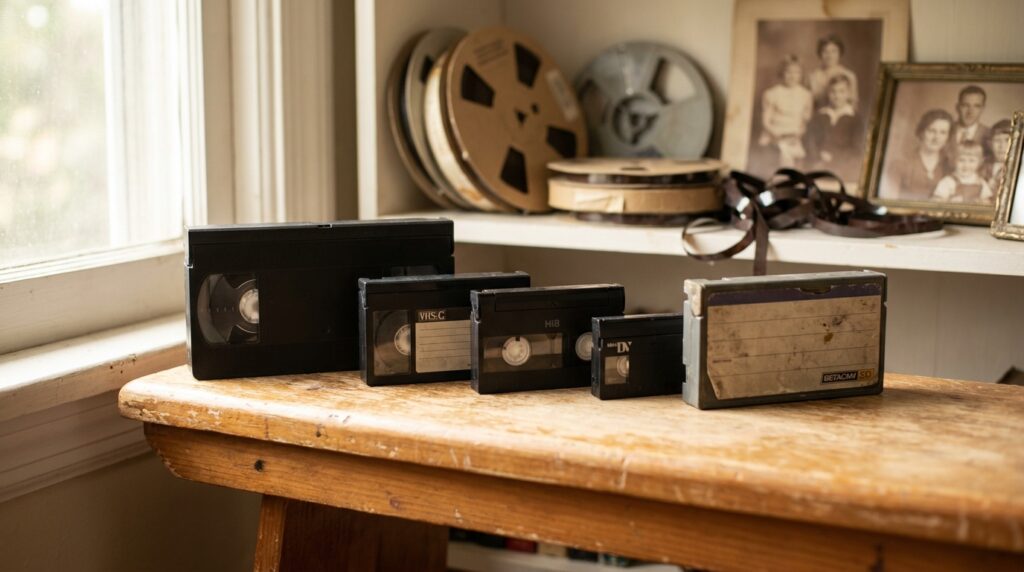
- VHS – the big rectangular cassette from the living room deck.
- VHS-C – a small VHS cassette from a camcorder; needs an adapter to play.
- 8mm, Hi8, Digital8 – palm-sized camcorder cassettes. Hi8 is sharper than 8mm; Digital8 records digitally onto the same shell.
- MiniDV – small digital camcorder tape. Digital recording, but the tape still ages and the decks that play it are getting scarce.
- Betacam – broadcast tape, priced separately because it needs different decks, with a bulk rate at 25 tapes and up.
Mixed piles are the norm. If your box holds tapes, slides and reels together, our guide to keeping 200+ mixed items in order with one naming scheme shows how we number things so the finished files make sense to your family. Film, by the way, never touches a tape deck: we scan it frame by frame, each frame captured as its own image rather than filmed off a projector screen, which is what keeps flicker and blur out of the result.
Getting tapes to the lab
- Drop off or walk in, if you are within about 75 miles of the Orange, CA studio.
- Ship them yourself – the default for orders of $100.00 or more.
- Order a prepaid shipping kit at $35.00, or $45.00 for large orders of 100+ tapes or 7,500+ feet of film.
Kits cap at 200 tapes or 10 Betacam per order; slide carousels and film reels of 600 feet or more are not kit-shippable. Return shipping is billed at the carrier’s rate on the final invoice and is never taxed.
Payment runs in three cumulative stages: $50.00 at checkout to buy your place in the queue, 50% of the pre-tax order when your media arrives, and the balance at completion against reconciled actual counts.
Choosing your delivered format
MP4 with H.264 is the practical default: it plays on phones, laptops, smart TVs and every editing program, Mac or Windows. MOV and MKV hold quality well but travel less easily. AVI and WMV are older and less universal.
Watch the compression, not the container. Light compression gives a large file that looks like the tape; heavy compression gives a small file that has quietly thrown detail away. Treat the drive files as your archive and any DVD as a courtesy copy.
FAQ
How long does it take to convert video tapes to digital?
Capture is real time, so a 2-hour tape takes 2 hours of machine time no matter who does it. Intake, inspection, quality checking and output sit on top. Our anticipated production cycle is about 6 weeks, a guide rather than a hard date, since queue depth and tape condition both move it. More detail in how long digitizing really takes and whether you can rush it.
Is it cheaper to convert VHS to digital myself?
For two or three tapes, usually yes, once you own a working deck. For twenty or more, the cost stops being money and becomes hours: twenty 2-hour tapes is forty hours of real-time capture, plus a VCR that still tracks properly and the risk of a fragile tape jamming in a machine nobody services anymore.
What happens if one of my tapes is damaged or moldy?
Do not force it into a player. A shedding or jammed tape can get worse in seconds. A lab can often clean, re-spool or repair a cassette and recover the contents, but some tapes genuinely cannot be saved, and an honest no beats a damaged original. Our page on how we protect your originals walks through intake, handling and return.
Will my old tapes look better after digitizing?
They will look like the tape looks now, captured faithfully and protected from further decline. Digitizing cannot add resolution VHS never recorded. What it does is stop the clock.
How much storage will my collection need?
Budget roughly 12.5 GB per 2-hour tape and about 6 GB per Betacam. Add film at about 31.75 MB per foot for HD, or about 50 MB per foot at 2K, and photos or slides at about 12 MB per scan.
Can I send tapes, film, slides and photos in one order?
Yes, and most people do. The main thing is a numbering scheme so finished files are findable. Remember that slide carousels and 600-foot-plus reels cannot travel in a prepaid kit.
Your next step
Nobody needs to commit today. Count your tapes, mark the ones that run past 2 hours, and get an instant estimate so you know the scale of the job before you decide who does it. Or bring one representative tape to the Orange, CA studio and we will tell you honestly what condition it is in. That advice costs nothing, and it is the cheapest way to find out how much time you still have.
Reviewed by Scott Foster, Founder of Legacy Digital Productions, Orange, CA - transferring film, tape, slides, photos and audio in-house since 2001 - last updated September 14, 2026.
Sources for this article
- Video tape priced per tape up to 2 hours; 4-hour tape = 2 units, 6-hour = 3 units
- ~12.5 GB per 2-hour tape; Betacam ~6 GB per tape; Betacam bulk rate at 25+ tapes
- Film HD 31.75 MB/ft, Professional 2K 50 MB/ft; photo/slide ~12 MB, enhanced photo ~24 MB; audio cassette ~96.5 MB/hr; reel-to-reel ~1.4 GB/hr
- Reel sizes: 3 inch ~50 ft, 3-4 min; 7 inch ~400 ft, 28-33 min
- VHS tape begins to degrade after 15 years (operator brief)
- Expected production cycle 6 weeks, anticipated not a hard date
- Local service area ~75 miles around Orange, CA studio; all work in-house, nothing subcontracted
- Shipping kit $35.00, $45.00 for large orders (100+ tapes or 7,500+ ft film); caps 200 tapes, 10 Betacam, 15,000 ft film; carousels and 600+ ft reels not kit-shippable
Facts drawn from this site's own documented knowledge and first-hand experience.