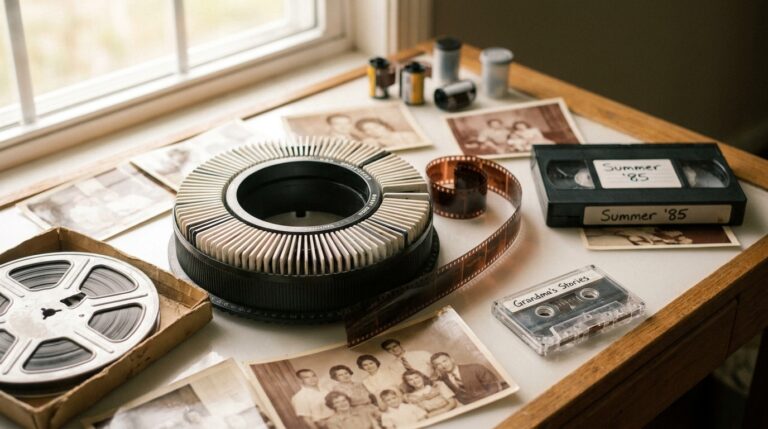
To convert film to digital, your reel is cleaned and inspected, then scanned one frame at a time at Full HD or 2K resolution with grain reduction and accurate color correction, and delivered as digital files on a hard drive, DVD, Blu-ray, USB drive or SD card. Legacy Digital handles 8mm, Super 8, 16mm and Technicolor reel-to-reel film using the same trusted process the Academy of Motion Pictures in Hollywood uses on its legacy archives. The most important thing to know: do not project old film to preview it first. That step is where most damage happens.
The belief worth correcting: “I’ll watch it on the projector first”
It feels responsible to check what is on a reel before you spend money digitizing it. It is actually the riskiest thing you can do. Every time you run old reel-to-reel film through a projector, the heat from the bulb dries the film out, and the projector’s moving parts rub against the emulsion and scratch the surface. That harm is irreversible. You cannot un-scratch a frame.
A proper transfer is the safe way to see what you have. You get to watch everything, in better light and better detail than a projector ever gave you, without putting the original through another hot, mechanical pass.
What “frame-by-frame” actually means
Older transfer methods pointed a camera at a projected image and recorded the result, which is why so many 1990s-era film-to-VHS transfers look dim, flickery and washed out. True frame-by-frame scanning is different: the scanner captures each individual frame of your film as its own image, then assembles those images into a digital video file. Nothing is re-photographed off a wall or a mirror box.
That approach is what makes grain reduction and accurate color correction possible, because the software is working with clean, discrete frames instead of a shaky moving picture. Our 8mm and 16mm film transfer service uses this process at Full HD or 2K resolution.
Every time you play an old reel-to-reel film, the projector bulb’s heat dries the film and the transport mechanism scratches the surface, and that damage cannot be reversed.
The formats, in plain language
Regular 8mm
The common home-movie format from roughly the 1930s through the 1960s. Small frames, usually silent, often on 3-inch or 5-inch reels.
Super 8
The 1960s-and-later replacement for regular 8mm. Same film width, but smaller sprocket holes, which left room for a bigger picture area and a noticeably better image.
16mm
Twice as wide as 8mm, so it holds far more detail. Used by serious hobbyists, schools, churches and news crews. Often has a sound stripe. Reels run long, too, and a 400 ft 16mm reel priced by the foot is the usual unit people are quoting when they compare labs.
Technicolor reel-to-reel
Commercially printed color film sold for home projection. Handled the same way as your home movies.
If you are not sure which you have, that is fine. Sorting formats is part of the job, and you do not need to identify anything before you ask for a free estimate.
DIY versus professional: an honest comparison
You have real options. Some people record the projected image with a camera. Some buy a consumer film transfer machine. Both can work, and both come with tradeoffs worth naming.
The quality of files produced by DIY methods varies a lot, and there is a greater chance of damaging the original film during the process. A high quality transfer machine can easily run into the thousands of dollars, and it takes technical know-how, test runs, and fiddling with exposure and contrast to get usable results. Professional services deliver reliable quality with less risk to the original, though they are not all alike: the budget mail-in services scan film at 480p standard definition, which is worth understanding before you ship your only copies to a service like Legacybox. If you want to weigh the home options first, see our breakdown of the three DIY methods for converting 8mm film to digital, and we walk through each method in more detail in our guide on how to convert 8mm film to digital.
The math usually decides it. If you have a shelf of reels you will scan once and never again, the equipment cost alone rarely pays off, which is why it helps to know what it really takes to convert film to digital before you buy anything. It also helps to run the numbers on the other side, since transfer work is priced by the foot rather than by the reel, and a standard 3 inch, 50 foot reel lands in a predictable range.
Why waiting costs you picture quality
Film is a physical object, and it keeps aging in the closet. Humidity and temperature have to stay in a narrow range or the film fades and becomes brittle. Magnetic tape, the other big family-archive format, degrades the same way over time, and VHS tapes start breaking down after about 15 years. Every year you wait, there is slightly less image left to capture. Digitizing earlier preserves more of what was originally there.
Handling matters too. Before scanning, film should be cleaned with a dedicated cleaning solution to lift the dust, dirt and debris that have settled into the frames over decades. Skipping that step bakes every speck into the final file.
How the process runs, start to finish
- You gather your reels, boxes and all, and request a quote. No need to sort or label.
- Each reel is inspected, repaired where needed and cleaned.
- The film is scanned frame by frame at Full HD or 2K resolution.
- Grain reduction and color correction are applied.
- You choose your delivery: hard disk, DVD, Blu-ray, USB drive or SD card.
- Your originals come home to you.
Legacy Digital has been doing this for over 20 years, for more than 20,000 satisfied customers.
FAQ
Can 8mm film be converted to digital?
Yes. 8mm film converts to digital easily, and you can receive the results on DVD, a USB drive, a hard drive or an SD card. Super 8, 16mm and Technicolor reel-to-reel film convert the same way.
Will converting film to digital damage my original reels?
A professional frame-by-frame transfer is designed to protect the original. The bigger risk to your film is running it through a projector, where bulb heat dries it and the transport scratches the surface. DIY conversion carries a greater chance of damage than a professional service.
What resolution should film be scanned at?
Full HD or 2K resolution is the standard we scan at, paired with grain reduction and accurate color correction so the digital file stays true to the original film.
Is it cheaper to convert film to digital myself?
Not always. A high quality film transfer machine can easily run into the thousands of dollars, and results depend on your own test runs and exposure settings. For a one-time project, a professional transfer is usually the better value and the lower risk.
How do I know what format my old reels are?
You do not have to know. Send them as they are. Identifying 8mm, Super 8, 16mm and Technicolor is part of the intake process.
Should I digitize film or videotape first?
Both film and magnetic tape degrade over time, and earlier digitization preserves more quality on either. If anything smells of vinegar, looks warped, or the tape shell is cracked, move that item to the front of the line.
A simple next step
You do not have to commit to anything today. Pull the box out of the closet, count the reels, and send us a note with what you have. You can get a simple quote and decide from there, at your own pace. The reels are not getting any younger, but the decision does not have to be rushed.
Reviewed by Scott Foster, Founder of Legacy Digital Productions, Orange, CA - transferring film, tape, slides, photos and audio in-house since 2001 - last updated September 7, 2026.
Sources for this article
- Frame-by-frame scanning at Full HD or 2K resolution with grain reduction and accurate color correction (Home page / Film Transfer)
- Same trusted process used by the Academy of Motion Pictures in Hollywood for legacy film archives, including original Hitchcock prints (8mm/16mm Film Transfer post)
- Projector bulbs dry film with heat and projectors rub against film causing scratches; damage is irreversible (Special B post)
- Humidity and temperature must be maintained or film fades and becomes brittle (Special B post)
- Over 20,000 satisfied customers; over 20 years converting film (Special B post)
- Formats handled: 8mm, Super 8, 16mm, Technicolor reel-to-reel (Home page, Special B)
- Output options: DVD, Blu-ray, hard disk, USB drive, SD card (8mm/16mm post, How to Convert 8mm post)
- A high quality transfer machine can easily run into the thousands of dollars (How to Convert 8mm post)
Facts drawn from this site's own documented knowledge and first-hand experience.