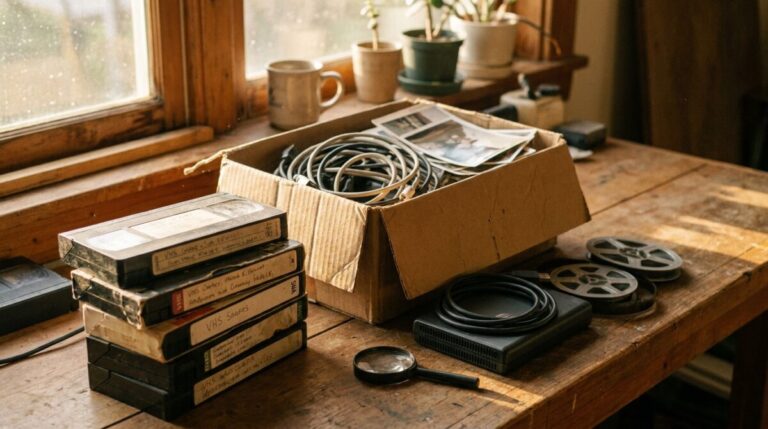
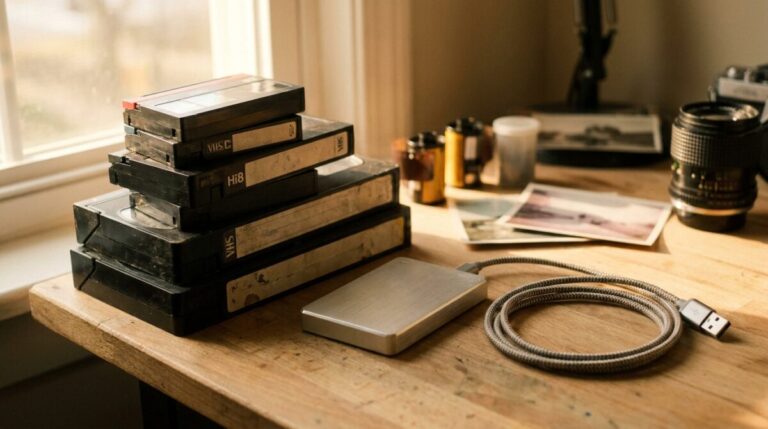
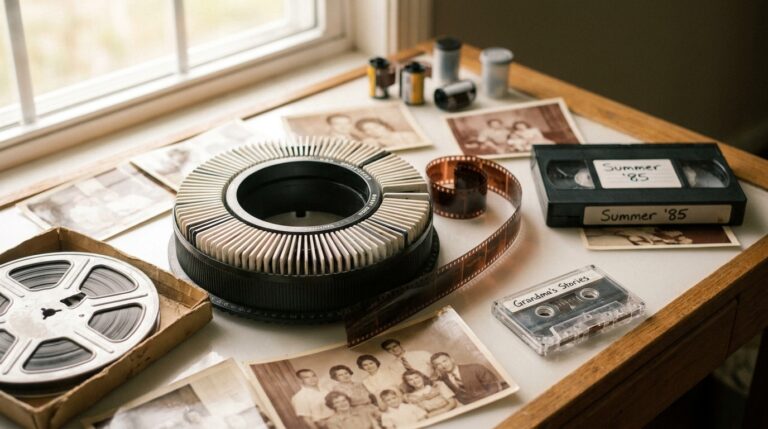
We protect your originals by never letting them out of our hands: every slide, reel and tape is logged at intake, tracked through the lab under a full chain of custody, handled by hand at one address in Orange, California, and returned to you with your new digital copies. Nothing is subcontracted or shipped overseas. Across more than a million reels handled, we have never lost an item. Legacy Digital Productions is a family-owned lab that has scanned in-house since 2001, so no box leaves the building.
In practice that means four things: one address with no forwarding, touchless frame-by-frame film scanning under cold LED light that never bakes a single frame, a numbered inventory that keeps every slide and reel matched to its own file, and your originals coming home to you alongside the drive. Slides go through carousel by carousel. Film is handled per foot, not force-fed. If a reel is too brittle to run, the reel stops and you get a phone call before anything else happens.
- Every order is handled in-house in Orange, CA. Nothing is subcontracted or sent overseas.
- Film is scanned frame by frame in HD 1080p or 2K under cold LED illumination.
- You keep your originals. You own the drive too.
- Slide carousels and film reels of 600 ft or more are not kit-shippable.
- 25 years, nearly 20,000 customers, 4.9/5 across 194 Google reviews as of August 2026.
The belief most people arrive with
Almost everyone asks some version of “will you send my box somewhere?” It is a fair question, because retail drop-off is a different model from a lab. Drop tapes at a CVS, Walmart, or Sam’s Club counter and that counter is a retail intake point, not a lab: the work is fulfilled elsewhere by a partner processor, which is how those programs are set up. Some mail-in labs run the same way and others scan in their own building, so the only reliable way to know is to ask a specific lab where the scanning physically happens.
But the belief worth correcting is subtler. Most people think the danger to their originals is the scanning itself. It usually is not. The variable most within your control is how many hands and addresses your box passes through, since each additional stop is one more point where a box has to be received, stored and re-labeled correctly. That is a general property of multi-stop logistics rather than a claim about any particular company, and plenty of mail-in labs do it carefully. What we can speak to is our own record: every item is logged at intake and tracked through the lab under a full chain of custody at one address in Orange, California, and across more than a million reels handled we have never lost an item. If a lab forwards work, ask them how they track it and what their own record is.
What happens between our loading dock and the bench
Arguing that transit is the risk is only fair if we show the inside of the building we are selling as the alternative. Here is the actual path.
- A box is signed in by the person who receives it, same day it lands, against the order it belongs to. Nothing is opened by whoever happens to walk past.
- Contents are counted and labeled before anything is scanned. A carousel of slides, a shoebox of loose ones, and three Super 8 reels are three separate inventories inside one order.
- Boxes live on assigned shelving inside the conditioned studio space, not in a garage, an unheated back room, or a vehicle. Film and tape hate heat and humidity swings more than they hate time.
- Overnight and over a weekend, media stays on that shelving in the locked building. Nothing sits outside, and nothing goes home with anyone.
- Work is pulled to the bench one order at a time and returned to its own shelf when the shift ends.
Our naming scheme for mixed orders exists so that 200+ items across formats cannot quietly swap identities on the way through, and your own numbering, grouping and aspect ratio survive the trip whether the box holds slides, 8mm reels or widescreen camcorder tapes. The final invoice reflects reconciled actual counts, not your estimate. If the shoebox held 412 slides and you guessed 500, the bill follows the real number.
Scanning: touchless, frame by frame, cold light
Film is scanned frame by frame rather than projected into a camera. Nothing rakes across the emulsion, and no hot projector lamp parks heat on one frame while the mechanism hesitates. Cold LED illumination is the mechanical reason a 60-year-old reel leaves in the condition it arrived.
Slides get the same discipline. Slide scanning with grain reduction and color correction runs $0.65 per slide at the current special rate against $0.45 per slide for a standard scan, and neither asks a cardboard mount to survive anything rougher than being lifted and set down.
Magnetic tape and film degrade on a clock, not on an event. Binder in videotape loosens, film dyes shift toward magenta, and acetate reels turn vinegary. Scanning earlier captures more of what is still there. Nothing later recovers it.
The one we could not save
A customer in Anaheim brought in a 5 inch reel of 8mm from the early 1960s, his parents’ first apartment, stored in his mother’s detached garage in Orange County since roughly 1978. On the bench it was one solid puck. The layers had welded, the edges were cupped, and opening the can released the sharp vinegar smell that means the acetate base has already broken down chemically. Test-pulling the leader lifted emulsion off in flakes.
I called him rather than keep going. What I said was: I can force perhaps ten seconds off the outer wrap and destroy the rest doing it, or you can spend real money with a specialist rehydration house and still get no promise. He chose to leave it intact and had us scan the other four reels from the same box, which had lived in a hall closet in the house and came through fine. Same family, same era, same film stock. Different shelf.
Film and magnetic tape lose quality every year they sit unscanned, and no scanner recovers what has already faded.
Across nearly 20,000 orders since 2001, my working estimate is that roughly one box in twenty arrives with at least one item we cannot fully recover. The three causes repeat: uninsulated garage or attic storage, water intrusion, and tapes left in a player or a car. Storage location predicts survival better than age does. That figure is my count from the bench, not an audited statistic.
Getting your media here with the fewest handoffs
| Method | Handoffs | Cost | Best for |
|---|---|---|---|
| Walk in / drop off | One – you to us | No shipping cost | Within ~75 miles of Orange, CA |
| Ship it yourself | Two – carrier each way | Your carrier’s rate | Preselected by default on orders of $100.00+ |
| Prepaid shipping kit | Two, with packing supplied | $35.00 ($45.00 for large orders) | Loads inside the kit caps |
Kit caps per order: 200 tapes, 15,000 ft of film, 10 Betacam, 5,000 photos, 5,000 slides, 5,000 negatives, 50 audio items. Slide carousels and reels of 600 ft or more are not kit-shippable. Orders of $2,000.00 or more may qualify for local pickup by us. Return shipping is billed at the actual UPS rate on the final invoice and is never taxed.
What to do before you pack
- Do not clean film or slides yourself. Household solvents and canned air do more damage than dust.
- Leave slides in their carousels or trays if that is the order you want kept.
- Do not rewind a brittle reel to check it. If it crackles, leave it alone.
- Pack tapes upright like books, not stacked flat.
- Write down what you think is on each item. Guesses help us catch mismatches.
- Photograph the open box before you close it. Thirty seconds, and it is your own record.
A worked example
Twelve Super 8 reels at 5 inches (200 ft each, silent, Platinum HD) plus 6 VHS tapes under 2 hours each.
Film: 12 x 200 ft = 2,400 ft at $0.35 per foot = $840.00. Tapes: 6 x $19.95 = $119.70. Services total $959.70, which clears the $250.00 threshold for the current 10% off conversion-services coupon and lands at $863.73 before drive, shipping, or California tax on the tangible drive. Storage comes to about 2,400 x 31.75 MB of film plus roughly 12.5 GB per 2-hour tape, so the system recommends a 1 TB drive at $150.00 with 10% headroom rather than the cheapest stick that technically fits.
To check your own footage math first, see our guide to pricing your reels before you ship. Per-foot pricing also makes the math transparent: a 3 inch reel is 50 ft and a 7 inch reel is 400 ft, eight times the film, so a flat per-reel price charges the same for both. Whether a lab prices per reel or per foot, ask what the price covers so you can compare quotes on the same basis.
How to vet any lab on this question
If you are nowhere near Orange, ask a candidate lab these six things. The answers tell you almost everything.
- Is the scanning done at this address, or is my box forwarded?
- Do you scan film frame by frame, and what light source?
- Do I get my originals back, and how is the return packed?
- How do you label and track items so a mixed order cannot get scrambled?
- Where does my box physically sit overnight and over a weekend?
- Is film priced per reel or per foot, and video per tape or per hour of runtime?
Copy-paste: “Hi, I have [X reels of 8mm and Y VHS tapes]. Is the scanning done in your building or forwarded to a partner? Is film scanned frame by frame, and what light source? Do I get originals returned, and how are they packed? How do you label mixed orders? Where does my box sit overnight? And is film priced per reel or per foot?” For why each answer matters, read the four questions that decide it.
FAQ
What format will my finished files be in?
Film and video come back as standard digital video files, and photos, slides and negatives as standard image files, playable without special software. Film is delivered at HD 1080p for Gold and Platinum levels or 2K for Professional. If you need a specific container or codec for an editing project, say so at intake and we will note it on the order. If the picture or sound is not what you expected once you play the files, we re-run the transfer at no charge and refund you if another lab can do better from the same original.
How long does the whole thing take?
The expected production cycle is about 6 weeks. That is an anticipated window, not a hard date, because queue depth and the condition of your material both move it. You get an email at each status change, and delivery tracking closes the order. If you are working against a deadline, here is how the timeline works and what rush service does to it.
Do you charge me for blank or unrecorded tapes?
No. A blank tape is not billed. The final invoice reflects reconciled actual counts, so you pay for what actually got scanned.
How does payment work if I am nervous about paying up front?
Three cumulative stages: $50.00 at checkout reserves your place in line, 50% of the pre-tax order is due when your media arrives at the studio, and the balance is due at completion plus California tax on tangible items. There is a $50.00 service minimum on conversion services.
Can I get DVDs as well as digital files?
Yes. DVD output for video is $5.00 per tape without a drive or $15.00 per disc with one, and film DVDs are $15.00 per disc holding up to 1,250 ft. Extra copies are $15.00 per disc. Treat DVDs as a convenience copy; the drive files are your real second original.
What about copyrighted material on my tapes?
We transfer client-owned home recordings and flag commercially produced content rather than duplicate it.
A low-pressure next step
You do not have to commit to anything to find out what you have. Call and describe the box, or run your reel sizes and tape counts through the estimator. If you are within about 75 miles of Orange, bring in one reel and watch how it is handled before you hand over the rest. That single visit usually settles the question better than any page can.
Reviewed by Scott Foster, Founder of Legacy Digital Productions, Orange, CA - transferring film, tape, slides, photos and audio in-house since 2001 - last updated September 5, 2026.
Sources for this article
- In-house in Orange, CA; nothing subcontracted or sent overseas
- Film scanned frame-by-frame HD 1080p / 2K, cold LED - Gold/Platinum HD, Professional 2K levels
- Slide scan $0.45 special standard; $0.65 special with color correction
- Film Platinum HD silent $0.35/ft special; 5 inch reel = 200 ft
- VHS special $19.95 per tape up to 2 hours; ~12.5 GB per 2-hour tape
- Film storage 31.75 MB/ft (Gold/Platinum)
- Drive sizing with 10% headroom; 1 TB $150.00; copy to customer drive $10.00
- Coupon 10% off orders with $250.00+ conversion services
Facts drawn from this site's own documented knowledge and first-hand experience.