Legacy Digital Productions is an owner-run lab in Orange, CA, and we compete directly with the mail-in box services and the retail drop-off counters named further down this page. Read the mechanics, not the adjectives.
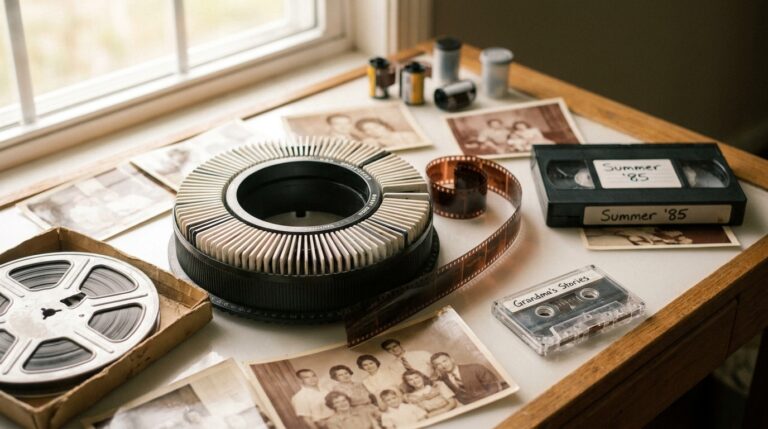
Yes. One order can hold slide carousels, 8mm and 16mm reels, VHS and camcorder tapes, loose and albumed photos, negatives and audio cassettes – all under one chain of custody, delivered on one drive. Your existing numbering becomes part of the file names, your box and carousel groupings become folders, and every format is scanned at its own native aspect ratio instead of being stretched into one common frame. Nothing is sorted, renumbered or re-shot to suit our workflow.
- Mixed means mixed: 200 tapes, 15,000 ft of film, 5,000 slides, 5,000 photos, 5,000 negatives and 50 audio items are the per-order kit caps.
- File names are zero-padded and prefixed with your own label, so they sort correctly in any file browser on any operating system.
- Groupings live in folders first, because folders survive being copied to a phone, a Mac, or a nephew’s laptop. Tags do not.
- Slides are scanned as 35mm frames, film at the frame’s own ratio, 4:3 tape stays 4:3. No crop to fill.
- Everything is handled in-house in Orange, CA. Nothing is subcontracted or sent overseas.
What “mixed archive” actually means on an invoice
People use the phrase loosely. Here it means one order number containing multiple price units at once, each billed by its own measure: film per foot, tape per two hours of runtime, slides and photos per image, audio per hour.
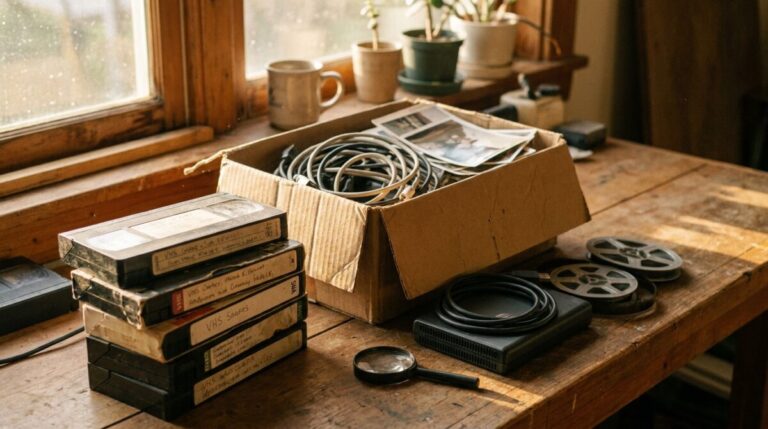
A typical estate cleanout arrives as three or four carousels, a shoebox, two albums, a dozen reels of Super 8 in a coffee can, and a stack of VHS. That is five billing units and about six different physical handling procedures, which is exactly why it usually gets split across three vendors and comes back in three unrelated file systems.
The single-vendor version is not a convenience pitch. It is the only way your slide numbering and your tape labels end up in the same naming scheme. Our slide scanning service with grain reduction and color correction runs alongside the film and tape work on the same order, so the delivery is planned once, at the start.
Slide carousels and large film reels of 600 ft or more cannot travel in a prepaid shipping kit. Those come in by drop-off inside our roughly 75 mile local service area around Orange, CA, or you ship them yourself with your own packing.
A worked numbering scheme across 240 mixed items
Say you send four Kodak carousels of 80 slides each (320 slides), 12 Super 8 reels, 6 VHS tapes, and 2 audio cassettes. Here is the pattern we apply.
The naming template is: <GROUP>_<SOURCE-ID>_<NNNN>.ext
| What you wrote on the item | Folder | Delivered filename | Why |
|---|---|---|---|
| Carousel tray “Europe 72” slot 7 | 01_Slides/Europe-72/ | EUR72_TRAY1_0007.tif | Slot order preserved; padded to 4 digits |
| Carousel “Europe 72” slot 112 | 01_Slides/Europe-72/ | EUR72_TRAY2_0112.tif | Continuous slot count across trays |
| Reel taped “Xmas 1968 #3” | 02_Film/ | FILM_R03_Xmas-1968.mp4 | Your reel number leads, your words kept |
| VHS spine “Graduation 1989” | 03_Tape/ | TAPE_V02_Graduation-1989.mp4 | Sequence + your label, no renaming |
| Cassette “Grandpa interview A” | 04_Audio/ | AUD_C01_Grandpa-interview-A.wav | Side/part letter retained |
Three rules make that pattern survive sorting. Numbers are zero-padded to four digits, so 0007 sorts before 0112 instead of after it. Group prefixes are short and constant, so alphabetical order is also chronological order. And no spaces, colons or slashes appear anywhere, because those break on cloud uploads and older Windows shares.
Zero-padding to four digits is the single detail that keeps a 5,000-slide archive from shuffling itself the moment you copy it to a phone.
Grouping logic: folders first, then metadata
Readers often arrive believing tags or a catalog app are the modern answer. They are the fragile answer. Tags written into a proprietary library die with the app, and most tag schemes vanish the instant a file is emailed or dropped in a text thread.
Folders (default)
Numbered top-level folders by format, then your own group names underneath. Copies cleanly to any drive, phone or computer, forever. This is what ships unless you ask otherwise.
Embedded metadata
Your group name and item label carried inside the image or video file itself, so it travels with the file even after a rename. Ask for it up front.
Sidecar / index sheet
A plain spreadsheet mapping every delivered filename back to the physical item it came from. Useful when the order runs past a few hundred items.
We keep strips and groupings organized the way you sent them, and the digital files are named and foldered to match, which is the same commitment we make when we keep negatives in their original order. If slides and photos arrive together, they are combined onto one drive with the groupings intact.
Aspect ratio: five shapes, no stretching
The mistake that ruins mixed deliveries is normalizing everything to one video frame. A 35mm slide is roughly 3:2. Regular 8mm and Super 8 frames are close to 4:3 but not identical to each other. VHS and camcorder tape is 4:3. Album pages and panoramas are whatever shape they are.
Force all of that into a 16:9 timeline and you either crop heads off or squeeze faces narrow. So we do not. Stills are delivered at the frame’s own proportions. Film and tape are scanned and encoded at their native ratio, and if you want a widescreen presentation later, pillarboxing adds neutral bars rather than removing image.
Oversized items follow the same principle: whole album pages and large prints are scanned as a single image at the same high resolution, which is why print size does not change the approach. Film is captured frame by frame, touchless, with cold LED light, so shrunken or brittle stock is never dragged across a hot gate.
Why the clock matters more than the catalog
Magnetic tape sheds oxide and binder as it ages, and film shrinks, curls and fades. Every year you wait, a scanner has less signal to work with, and no naming scheme recovers what the emulsion already lost. Earlier digitization simply preserves more picture and more sound.
That is the case for doing the whole mixed pile in one pass rather than the “easy stuff” now and the odd formats someday. Someday is when the odd formats are worst.
What a mixed order costs
Current special rates: slides at $0.45 per slide standard, or $0.65 per slide with color correction. Film at Platinum HD, which is HD plus full color correction and grain reduction, is $0.35 per foot silent. Video tape is $19.95 per tape up to 2 hours, with a 4-hour tape counting as 2 units. Audio cassette is $20.00 per hour.
Worked example, using the order above: 320 slides with color correction at $0.65 = $208.00. Twelve Super 8 reels on 3 inch reels (50 ft each, 600 ft total) at $0.35 per foot = $210.00, plus the $5.00 per-reel small-reel technical surcharge on 12 reels = $60.00. Six VHS at $19.95 = $119.70. Two cassettes at $20.00 = $40.00. Services total $637.70, which clears the $250.00 threshold for the current 10% off conversion services coupon. Drives and shipping are never discounted, and a drive does not count toward the $50.00 service minimum.
Note the mechanic difference worth understanding: the box services and the retail counters at CVS, Walmart and Sam’s Club price film by the reel and route the work out, most commonly to Capture / YesVideo in Norcross, GA. We price film by the foot, in our own lab. A 3 inch reel and a 7 inch reel are one line item to a per-reel vendor and eight times apart in actual footage. If you want that math laid out, see how to price your reels before you ship.
How the order runs
Payment is in three cumulative stages: $50.00 at checkout to buy your place in line, 50% of the pre-tax order when your media arrives at the studio, and the balance at completion on reconciled actual counts. The anticipated production cycle is 6 weeks, not a hard date, since queue and complexity vary. Throughout the run your originals stay logged and tracked under a documented chain of custody at our Orange, CA lab, and nothing is subcontracted or shipped overseas. Conversion of your own media is a non-taxable service in California; only tangible output like drives and DVDs is taxable, and return shipping is never taxed.
We have been transferring film and tape in our own lab for 25 years, with nearly 20,000 satisfied customers since 2001 and a 4.9/5 Google rating across 192 reviews as of August 2026. You keep your originals; the drive is yours.
Your checklist before you send a mixed pile
- Leave it as it is. Do not re-sort, unbox or strip labels – the existing order is the information we preserve.
- Write group names on the outside of each box, tray or bag, and keep the wording you already use.
- Tell us the one grouping that matters most (by trip, by decade, by person), so folders follow that logic.
- Ask for an index spreadsheet if the order runs past a few hundred items.
- Say up front if you want embedded metadata, since it is set before the run, not after.
- Keep carousels and 600+ ft reels out of a shipping kit; drop off or pack those yourself.
The one mistake that forces a full re-scan or re-export: peeling off or renumbering your own labels before shipping, and deciding on the grouping after delivery. Names and folders are written during the run. Change the scheme afterward and the files have to be re-exported to match, and if the physical labels are already gone, the mapping cannot be rebuilt at all.
FAQ
Can you scan slides, film and VHS all on the same order?
Yes. Film, every video tape format, photographs, slides, negatives, documents and audio can run on one order under one chain of custody and come back as one organized archive. See how a mixed archive is handled end to end, and how your existing numbering and each format’s aspect ratio survive the trip.
Do I need to sort or number my photos and slides first?
No. Send them exactly as they are, in shoeboxes, envelopes, bags, albums or trays. Whatever grouping you already have is the grouping we keep, and it becomes the folder structure.
What file formats and outputs do I get back?
Standard MP4 for everyday viewing on film and tape, with MOV, ProRes, image sequences or uncompressed masters available for preservation or presentation work. We confirm targets before the run. DVD output is $15.00 per disc.
Will my old 4:3 videos be cropped to fit a widescreen TV?
No. Tape is delivered at its native 4:3, and stills at each frame’s own proportions. Widescreen playback adds neutral side bars rather than cutting the image.
How long does a large mixed order take?
The anticipated production cycle is 6 weeks. It is an estimate, not a promise, because queue depth and the condition of the media both move it.
How much storage will my archive need?
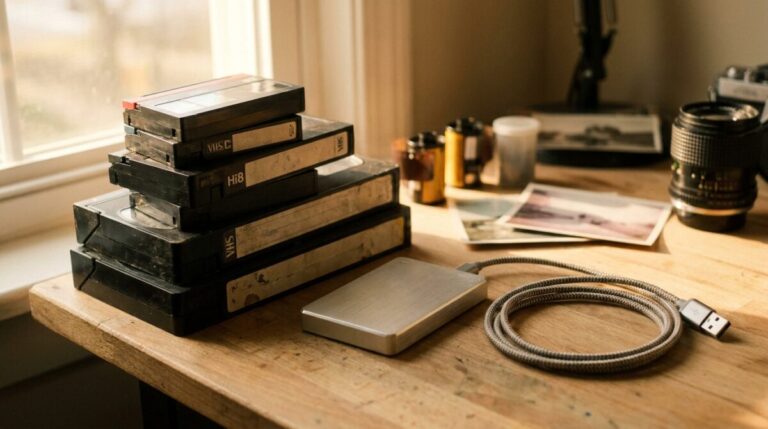
Roughly 12 MB per slide, photo or negative frame, about 31.75 MB per foot of film at Platinum HD, and about 12.5 GB per 2-hour tape. The system sizes the recommended drive with 10% headroom, from a 16 GB flash drive at $15.00 up to a 5 TB external at $300.00.
A low-pressure next step
You do not have to commit to anything to find out what your pile costs. Run the numbers on a free instant quote, or bring one carousel and one reel to the Orange studio and see what comes back before you decide about the rest. The memories are irreplaceable. The decision does not have to be.
Reviewed by Scott Foster, Founder of Legacy Digital Productions, Orange, CA - transferring film, tape, slides, photos and audio in-house since 2001 - last updated September 4, 2026.
Sources for this article
- Kit capacity caps per order: 200 tapes, 15,000 ft film, 5,000 photos, 5,000 slides, 5,000 negatives, 50 audio items
- Slide carousels not kit-shippable; large film reels 600+ ft not kit-shippable
- Local service area ~75 miles around Orange, CA studio
- Everything handled in-house in Orange, CA; nothing subcontracted or sent overseas
- Slide scan special $0.45; with color correction $0.65
- Platinum HD silent special $0.35/ft; HD plus full color correction and grain reduction
- Video tape special $19.95 per tape up to 2 hours; 4-hour tape = 2 units
- Audio cassette $20.00/hour
Facts drawn from this site's own documented knowledge and first-hand experience.