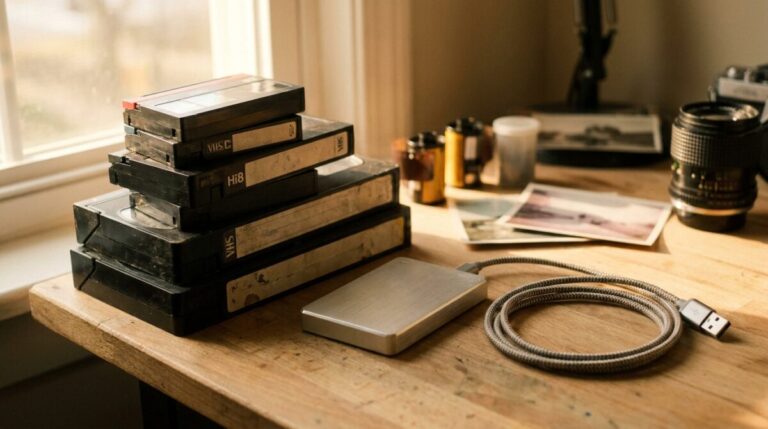
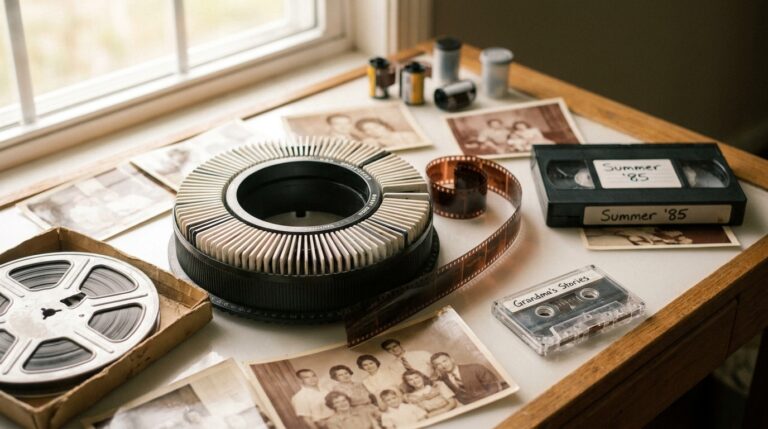
Legacy Digital is an independent, family-run lab in Orange, California, and every scan happens in our own building – so the queue we quote is our own hands, not a shipping counter’s guess.
Plan on about 4 to 6 weeks for a standard order, with 6 weeks as our anticipated production cycle, and yes, rush service is available at additional cost – it typically brings an order in inside 1 to 2 weeks depending on size. Rush is quoted the week you call, because it depends on where the queue stands. What no fee changes: videotape plays back in real time, and damaged media needs prep before it runs.
- Anticipated production cycle: 6 weeks. Not a hard date.
- Rush: additional cost, typically 1 to 2 weeks, size depending.
- A 2-hour tape needs 2 hours of monitored playback. For everyone.
- Shipping is on top of production time if you mail in.
- You get an estimated timeframe with your quote, so a date can be planned around.
Estimate your own order before you call

You should be able to do the arithmetic yourself. The table below uses our own working assumptions: tape at real-time playback billed per 2 hours of runtime, film at roughly 3.6 seconds of runtime per foot, and standard queue against our 6-week anticipated cycle.
| Order | Machine time floor | Standard | Rush |
|---|---|---|---|
| 20 VHS tapes (2 hr each) | 40 hours playback | Typically 3 to 6 weeks | Typically 1 to 2 weeks |
| 10 reels of 8mm, 5 inch (200 ft each) | 2,000 ft, about 2 hours runtime | Typically 3 to 6 weeks | Typically 1 week |
| 500 slides in carousels | 500 individual frames | Typically 3 to 6 weeks | Typically 1 week |
| 50 audio cassettes (60 min each) | 50 hours playback | Typically 4 to 6 weeks | Ask – at kit cap for audio |
Read those standard columns as the same 4-to-6-week window, not as four different promises. Order size mostly changes how much of that window your work occupies, while the queue in front of you decides when it starts.
Where the weeks actually go
The four stages of your order
Most people picture a machine that eats a box and returns a drive. Only one of the four stages is scanning.
Media arrives and is checked in against what you said you sent, and counts are reconciled – the final invoice reflects actual counts, not your form estimate, and everything is logged under a chain of custody that keeps your originals in our hands. On a mixed box, that log is also where the naming scheme that keeps 200-plus slides, reels and tapes in order gets set. Then prep: film inspected and spliced, tapes checked for shedding or a snapped leader. Then the scan. Then output, file organization, and your drive or discs.
Slides are the odd one out. Per frame they are quick, but a carousel is not one item, it is potentially a hundred. Our slide scanning service with grain reduction and color correction handles loose slides, boxes and carousels, and the frame count drives the clock, not the box it came in.
The one thing rush money cannot buy
Standard queue vs rush
Videotape plays back in real time with no fast-forward that preserves the picture, so 25 two-hour tapes is roughly 50 hours of monitored playback before anyone touches file organization. That floor applies to every lab on earth, including the ones advertising five-day turnaround.
Rush does not speed the machine. It moves your queue position and puts staff hours on your order sooner. That is worth paying for when you have a date. Rush gets harder or impossible when the order is very large – our shipping kit caps at 200 tapes or 15,000 ft of film per order for a reason – or when media needs repair first, because prep time is not compressible.
Film behaves differently from tape. Frame-by-frame touchless scanning captures each frame individually instead of filming a projected image, and cold LED illumination means no hot projector lamp on the emulsion. Footage still sets the scale: a 7 inch reel holds about 400 ft, roughly 28 to 33 minutes.
Which weeks are worst
Backlogs are seasonal and predictable enough to plan around. They swell ahead of the winter holidays, and again before graduation and reunion season in late spring. The quietest stretches in a normal year are mid-winter after the holidays and late summer.
If your event is in December, the useful move is shipping in August or September, not October. If it is a June graduation, February beats April. Working backward from the date is the single biggest lever you control, and it costs nothing.
The orders that go smoothly are the ones where the date was on the table from the first conversation. Twenty-five years in one building, and that has not changed.
The mail-in math nobody prints on the box
Here is the belief worth correcting: the turnaround advertised on a retail kit is usually the lab’s internal handling window, not your wait. Tapes handed to a drugstore or warehouse-club counter are routed to a large consolidation lab and back. Customer reports on Yelp describe four to six week waits against a promised five-day turnaround.
The mechanic outlives any number. A consolidator batches thousands of orders for throughput, so your box waits for a batch to fill. An in-house lab runs a queue you can call and ask about by name – the difference we lay out in our guide to choosing a VHS to digital service.
Mail-in also adds transit at both ends. Return shipping goes at carrier rate through UPS, billed on the final invoice and never taxed, and delivery tracking auto-completes the order. Within about 75 miles of the Orange studio you can drop off and pick up and skip both legs.
Waiting has a price too
Magnetic tape and film degrade on a clock that does not stop. Tape binder absorbs moisture and sheds. Color film shifts and fades, and acetate stock can turn vinegary in a warm garage. Every year you wait leaves less to recover, and no scanner recovers what is already gone. Earlier digitization simply preserves more.
What you pay, and when
Payment runs in three cumulative stages, so nothing large is due before the work is real. $50.00 at checkout buys your place in line. When your media reaches the studio you come up to 50% of the pre-tax order. The balance is due at completion, plus California tax on actuals and any additional charges.
There is a $50.00 service minimum on conversion services, and output media such as drives does not count toward it. Rush is quoted per order rather than published, for the same reason we will not name a calendar date sight unseen.
A low-pressure next step
If you have a hard date, say the date out loud when you ask for a quote – that one sentence changes how we build the estimate. If you do not have one, run an instant quote at your own pace and ship when you are ready. Either way, you are not choosing between fast and careful. You are choosing when to start the clock that protects what is left.
FAQ
How long does it take to convert my slides to digital files?
Usually about 4 to 6 weeks in the standard queue, moving with the season. Total slide count drives the clock more than whether they arrive loose, boxed or in carousels. Rush is available at additional cost. Our full answer on slide conversion turnaround has more.
Can I pay a rush fee to jump the line?
Yes. Rush is available at additional cost, quoted per order the week you call, and typically completes in 1 to 2 weeks depending on size. It moves your queue position and assigns staff hours sooner. It cannot shorten real-time tape playback or skip prep on damaged media.
What file formats and media do I get back?
Delivery is digital video and image files on the output media you choose – a flash drive from 16 GB up to 512 GB, or an external hard drive from 1 TB to 5 TB – and the drive is yours. DVDs are optional at $15.00 per disc. Ask for exact codec and bit-depth specifics with your quote, since they follow the scan level you select.
Why won’t you give me an exact completion date?
Because a reel needing splicing or a tape needing cleaning adds hours nobody can predict from a form. You get an estimated timeframe with your quote and can call for status any time. Our film turnaround answer says the same thing plainly.
Does a bigger order always take longer?
For tape, close to proportionally, since playback is real time. For film and slides the relationship is gentler, because scanning runs continuously once a reel or tray is loaded. Mixed orders route to separate stations, so a small mixed order can take about as long as a larger single-format one, and your numbering, grouping and aspect ratio still come back intact.
What happens with blank or unusable tapes in my box?
Counts are reconciled at check-in and the final invoice reflects the actual usable count rather than your estimate. That reconciliation happens before production, so it does not add to your wait.
Reviewed by Scott Foster, Founder of Legacy Digital Productions, Orange, CA - transferring film, tape, slides, photos and audio in-house since 2001 - last updated September 5, 2026.
Sources for this article
- Expected production cycle: 6 weeks (anticipated, not a hard date; queue and complexity vary)
- FAQ posts: usually about 4 to 6 weeks out, depends on season; rush available at additional cost, completing in one to two weeks depending on size
- VHS guide: playback is real time, 25 tapes is roughly 50 hours of monitored playback
- Yelp customer reports describe four to six week waits against a promised five-day turnaround
- Video tape billing: per tape up to 2 hours; 4-hour tape = 2 units
- Film runtime: ~3.6 seconds per foot; 5 inch reel = 200 ft; 7 inch reel = 400 ft, 28-33 min
- Kit capacity caps: 200 tapes, 15,000 ft film, 50 audio items
- Service minimum $50.00; output media does not count toward it
Facts drawn from this site's own documented knowledge and first-hand experience.