Convert Your 8mm Video Tapes to Digital.
Three formats, one little cassette, and no camcorder left to play them
Video8, Hi8, and Digital8 all shared the same small camcorder cassette through the late 80s, 90s, and early 2000s. We transfer every one to digital MP4 at roughly 12.5 GB per two-hour tape, and you never have to know which is which; we identify them for you.
Get a Free 8mm Video QuoteIn-house in Orange, CA since 2001. Over a million reels handled, never one lost.
$19.95
per two-hour tape (regularly $28.50). Video8, Hi8, or Digital8.
Since 2001
Hollywood 's Choice
In-House Processing
Expert Technicians
Trusted with the tapes for Netflix's Lucy and Desi and thousands of family libraries · All video tape formats →
Why Now
8mm camcorders were the only common way to play these tapes, and working ones are now rare. The tapes are stranded without the hardware.
Video8 and Hi8 are magnetic analog tape, so the signal weakens and the picture degrades a little more every year.
Like all tape, 8mm can turn sticky or grow mold in storage. Caught early most still transfer; left too long, they do not.
These cassettes hold birthdays, recitals, and vacations from the camcorder era, often the only moving record of those years.
8mm Video Transfer Pricing
One flat rate across all three formats, no need to separate them.
Video8, Hi8, and Digital8 are all the same price. Longer tapes count as multiple two-hour tapes.
Delivery on flash drive or hard drive, and optionally on DVD: $5 per disc for disc-only orders, $15 per disc when a drive is included. $50 order minimum. We skip blank footage and never charge for the empty parts of a tape.
Why Our 8mm Video Transfers Look Better
We encode at far higher quality than the warehouse standard, preserving the fine detail these small-format tapes actually hold.
A technician monitors each capture and tries troublesome tapes in multiple decks for the best result.
We trim blank footage and never charge for the empty parts of a tape.
Your tapes are digitized by our own team in Orange, California, never subcontracted or sent overseas.
The 8mm Video Family, Explained
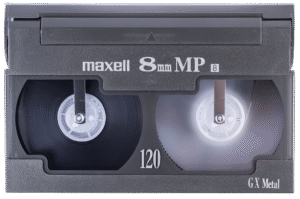
All three formats use the same size cassette, about the size of an audio cassette, so they are easy to mix up. Here is how they differ, and you do not need to sort them before sending.
The original analog 8mm format, introduced by Sony in 1985. Compact and good quality for its size, it replaced Super 8 film cameras for a generation of families.
The higher-resolution analog upgrade from 1989, noticeably sharper than Video8 and VHS. A favorite prosumer camcorder format in the early-to-mid 90s.
Introduced in 1999, Digital8 records digital video on the same 8mm-style tape, giving cleaner results while staying compatible with the earlier shells.
Since the cassettes look nearly identical, we tell which is which by the recording itself. Send a mixed box; we sort and label everything.
How It Works
Getting your 8mm video tapes to us is simple, and your originals always come home.
Send it to us
Free local pickup across Southern California, a secure prepaid shipping kit by mail, or drop off at our Orange, CA counter.
We digitize it in-house
We identify Video8, Hi8, or Digital8, capture each in real time at low compression, and trim the blanks.
You relive it
Get your videos as MP4 on a drive or DVD to share and stream, and your original tapes come back with them.
Which Tape Do You Have?
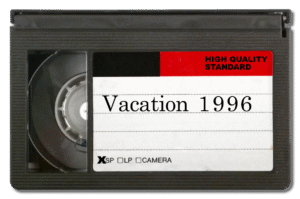
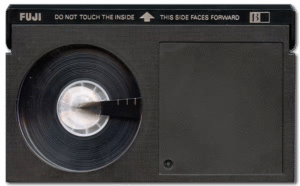
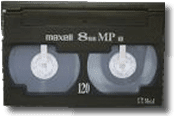
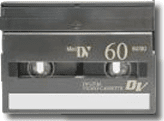
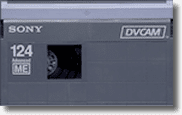
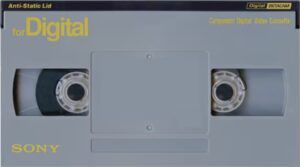
Not sure what you are looking at? Match your tape below and tap it for the details, or just send a mixed box and we sort and identify them for you.
Consumer and Home Formats
Professional & Broadcast
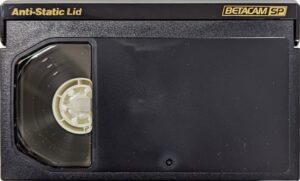
Low-compression MP4 or MOV files delivered on flash drive, hard drive, the cloud, or long lasting archival DVD.
If you are not happy with your transfer, we redo it until you are.Handled entirely in-house in Orange, California. Your tapes never leave our facility or the country.
"Thank you Legacy Digital for putting my cherished family videos to digital. You showed care and professionalism towards the film. Delivered on time as you promised. Now my family will have this stuff for years."
- Andrew G.
Google Review
"I just has an old VHS of our ship's decommissioning given to me and I had no idea what to do with it. Legacy took care of that (DVD and MP4) and were very friendly and professional. I would use them again and recommend them to others."
- D. O.
Google Review
8mm Video Questions
Below are the most common questions we get about coneverting negatives to digital format. If you have other questions, please give us a call. We're happy to answer them.
Usually, yes, and often they look better than you expect after color correction. Some film is degraded beyond a perfect image, but we deliver the best result the film can give.
Gold HD is a clean HD scan. Platinum HD adds scene-by-scene color correction and grain reduction and is our most popular. Professional 2K is the highest resolution. See the film hub for full pricing.
Regular 8 has larger, more frequent sprocket holes and a smaller frame; Super 8 has smaller holes and a bigger picture. You do not have to know, we identify every reel for you.
From $0.28 per foot at the Gold HD special (regularly $0.40). A typical 3-inch reel holds about 50 feet, or roughly $14. You pay only for the footage we actually transfer, never per reel.
MP4 files by default (MOV or ProRes on request) on a flash drive or hard drive, and optionally on playable DVD or Blu-ray for $15 per disc. One disc holds about 1,250 feet of film. Your original reels always come home too.
Yes, a $50 order minimum, not counting drives.
On audio, billing is by the hour of sound we actually recover, and blank tape is never charged, so hourly work and any reel minimum simply count toward the order minimum together.
With the current discount, transfers start at $0.28 per foot ($14.00 per standard 50 ft. reel) on the Gold tier. Sound film adds $2.00 per reel. Larger reels are simply more feet: a 200 ft. reel counts as four standard reels, a 400 ft. reel as eight. Use the online estimator for a down-to-the-penny quote; it assumes full reels, so most clients pay slightly less than their estimate.
The main reason you want to put your family memories on DVD is that DVDs last forever right? WRONG!! All DVDs have a shelf life and do fail eventually. And, once a disk starts to go bad, it becomes unreadable. So, instead of the picture fading or degrading a little at a time, you go from perfect to nothing in one step.
Most services like ours use regular disks. They are said to last 2 to 5 years. We don’t think that is acceptable so we use the top of the line long lasting archival DVDs available. These disks are superior for two reasons: First, the construction of the disk is much more durable. It can take punishment and age better than any other disk. Second, the recording layer is built to a true archival standard.
This archival layer holds information far better than the dyes and metals used in ordinary disks. The result, a disk that is thoroughly tested and rated for a shelf life of over 100 years. These discs have been tested against every major maker of DVDs. They stand out as far superior in every case. That’s why we insist on using them, and that’s why you should insist on getting them.
Why doesn’t our competition use them?
Because they are many times more expensive than any other disk. When you want your data to outlast your grandchildren, insist on the best long lasting archival DVDs on the market. And to play it safe, we recommend that you order a backup copy to keep at a second location just in case. (Blu-ray discs are not made to the same archival standard, but we do use the highest rated Blu-ray discs available. Again, backup copies are highly recommended.)
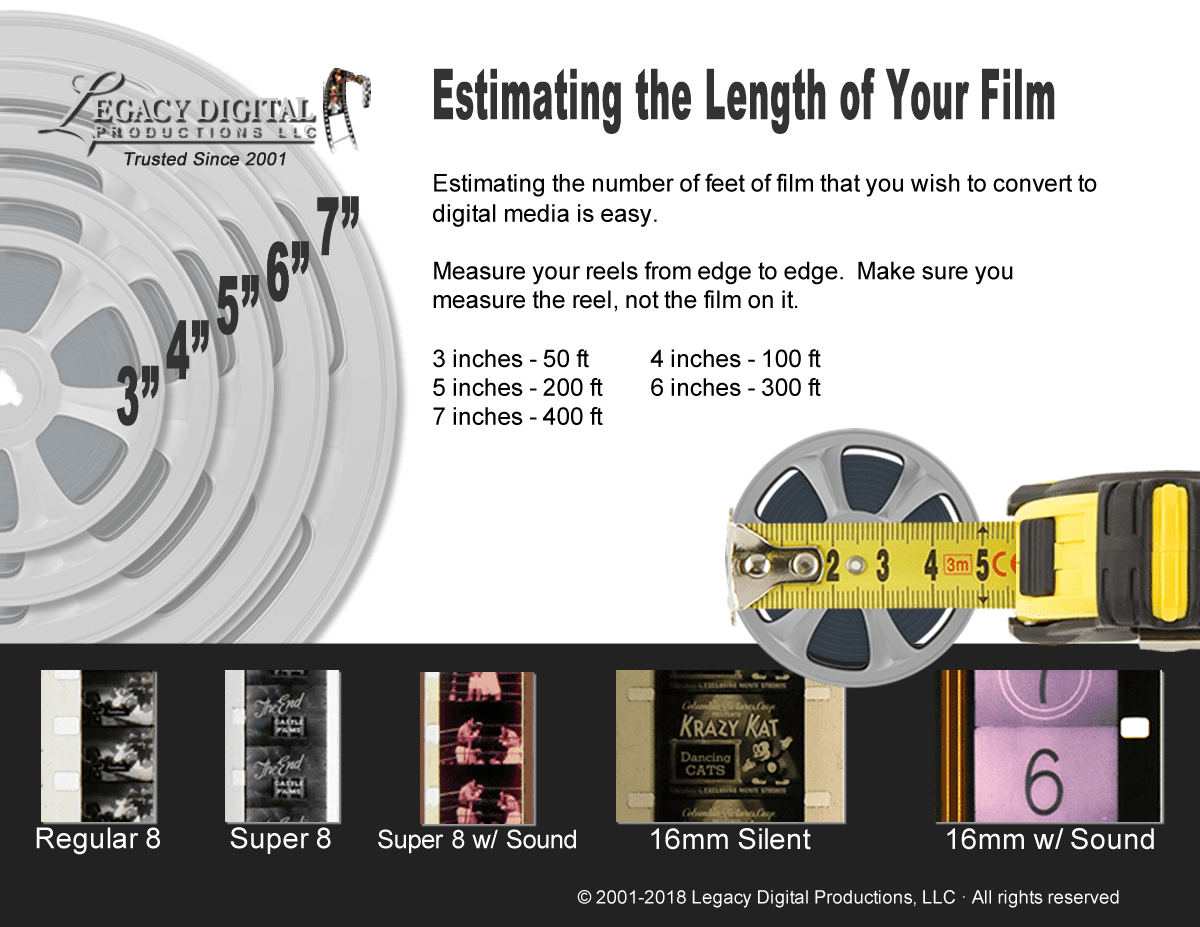
Regular 8 and super 8 mainly differ by the type of reel they are on. The center hole on a regular 8 reel is too small to fit a pencil through. On Super 8 film, the center hole is almost as large as a dime. If your Super 8 has sound, it will have chocolate brown stripes along one or both edges of the film.
8mm film of any type has holes on only one side and is skinnier than your finger.
16mm film is about as wide as a man’s index finger. If it has holes on both sides (make sure you check the actual film, not the white leader) it is silent film. If it has holes on only one side, it is sound film. 16mm film can come on reels as large as 1600 ft (about the size of a giant pizza).
The result you will get from your film transfer can vary greatly depending on the type of process you use. At the bottom of the list are services that will run your film on a projector and videotape the screen for you. This would represent the poorest quality process. This would be about a 2 on a 1 – 10 scale for quality.
The next step up would rate at about a 5 to 6 on the scale. This process is commonly called a telecine transfer. This machine looks like a projector, but instead of having a lense, it has a video chip that captures the image from the film. This yields OK results, but the original resolution is one fourth of what a dvd is capable of, and if you capture the film that way, you cannot take advantage of the full quality a dvd is capable of showing.
Our process would rate a 9.5 on the scale. The only way to get a better quality picture is to go to the high end Hollywood type transfer houses that usually do work for the studios. They can charge 10 to 15 times more than our prices and are certainly out of reach for family budgets.
When we transfer your film to dvds, we take the time to do it right. First we clean and recondition your film. We use the same film cleaner and process that motion picture studios use on their archival footage and master prints. (Watch out for the guys who use isopropyl alcohol. It is a drying agent and will damage your film in time. This saves them about $60.00 per quart, but the person who pays the price is you.)
We then scan your film frame by frame directly to lossless computer files. This frame by frame capture gives you superior results, it is much safer than other methods, and has much better color, contrast, and clarity. Frame captures are done by a high definition 1080p optics system that will trump other telecine systems every time. Frame scans are also natively high definition, 1080p resolution so there is no attempt to upscale inferior footage.
Before we burn your files to disk, we take the time to go through the footage and adjust color, contrast and brightness to enhance the picture quality even further. We can’t always make old film perfect, but we can make it look as good as possible.
We use only the best professional, long lasting archival DVDs for top of the line performance and longevity (Blu-ray discs are not made to the same archival standard, but we do use the highest rated discs available). These top of the line disks are tested and rated for an over 100 year shelf life. Don’t believe everything you hear about dvds lasting forever, the disks you use make all the difference. These disks are the longest lasting media of any kind. They also cost us about 10 times more than other disks.
That’s why most people don’t use them, but again, the person who pays is you. Our disks are also NOT copy protected. You are welcome to make copies of your product all you want. I recommend at least one backup copy on the long lasting archival DVDs, but you will not have to wonder if I am still in business 5 or 10 years in the future if you want another copy. You will be able to do it yourself.
The Camcorder Era Is Fading in a Shoebox.
Get a free, itemized quote. We identify and count every tape, tell you the exact cost, and your originals always come home.
Get My Free 8mm Video QuoteOr call (888) 405-2685 · Orange, CA · In-house since 2001