To convert VHS to DVD you need two things: a way to play the tape and a way to record the signal. That means either a working VCR paired with an A/V-to-USB capture device and a computer, or a transfer service that already owns professional-grade decks. The bigger decision is what you burn the results onto. Ordinary DVDs are said to last 2 to 5 years, while professional long-lasting archival DVDs are tested and rated for over 100 years. Choosing the wrong disc undoes the whole project.
The belief worth correcting: “DVDs last forever”
Most people converting VHS to DVD assume they are moving memories from something fragile to something permanent. They are not. Every DVD has a shelf life and every DVD eventually fails. Worse, a disc does not fade gracefully the way a photograph does. Once the recording layer starts to go bad, the disc becomes unreadable. You go from a perfect picture to nothing in one step, with no warning.
That is why the disc grade matters more than almost any other choice you make. Archival discs are superior for two reasons. The physical construction is far more durable and ages better than any other disc, and the recording layer is built to a true archival standard rather than relying on the dyes and metals used in ordinary discs. The result is a disc thoroughly tested and rated for a shelf life of over 100 years. Most services use regular discs because archival discs cost many times more.
Ordinary DVDs are said to last 2 to 5 years. Professional long-lasting archival DVDs are tested and rated to last over 100 years.
Your tape is already on the clock
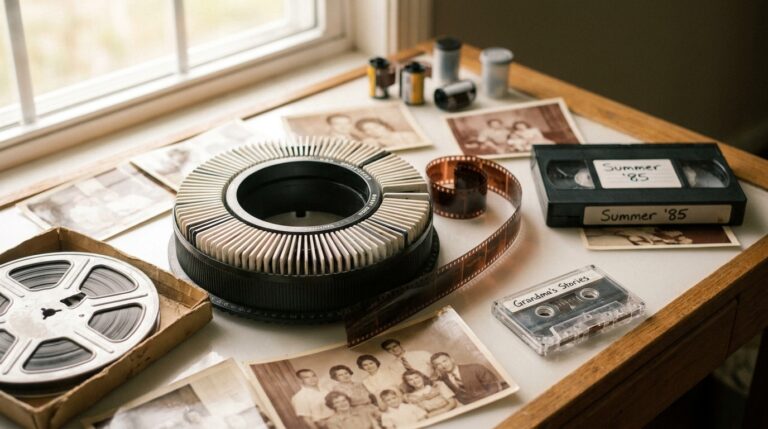
VHS tapes begin to degrade after about 15 years. If your tapes were recorded in the 1980s or 1990s, that clock ran out long ago, and every year of storage costs a little more color, a little more of the magnetic signal, and a little more tape strength. The same is true of film. Whatever quality is still on the tape today is the best quality you will ever get out of it, which is the simplest argument for digitizing sooner rather than later. If you also have reels in the closet, the same urgency applies, and our 8mm and 16mm film to digital transfer service covers that side of the collection. You can read more about tape lifespan in our guide to how long VHS tapes last before they degrade.
Doing it yourself: what the setup actually involves
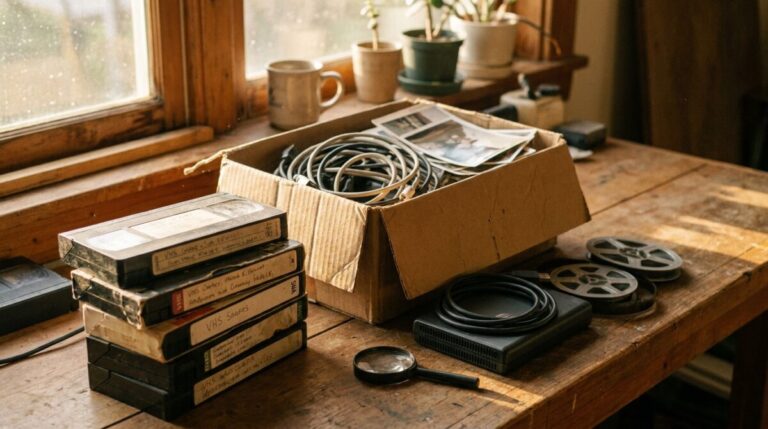
Home conversion is realistic if you have the gear and the patience. The basic path: buy an A/V-to-USB adapter cable, plug it into your computer’s USB 2.0 port, connect your analog video source using the included RCA composite or S-video cables, then use the accompanying software (or a program of your choosing) to transfer the recording in real time. From there you can edit and burn to disc.
Two catches trip people up. First, real time means real time. A two-hour tape takes two hours, and you have to be nearby to catch tracking problems, which is why time is the main factor when weighing your options to convert video tapes to digital. Second, a capture device has no tape mechanism of its own. It only digitizes a signal, so you still need a working VCR or a VHS-capable camcorder with the right adapter to play the tape and send that signal out. If you do not own one, that is usually the deciding factor in favor of a service. Our honest breakdown of what VHS to digital converters do well and what they miss goes deeper on this.
Using a transfer service instead
A service handles playback on professional-grade recording equipment, which matters most on tapes with tracking issues or worn spots. A few practical details worth knowing before you box anything up:
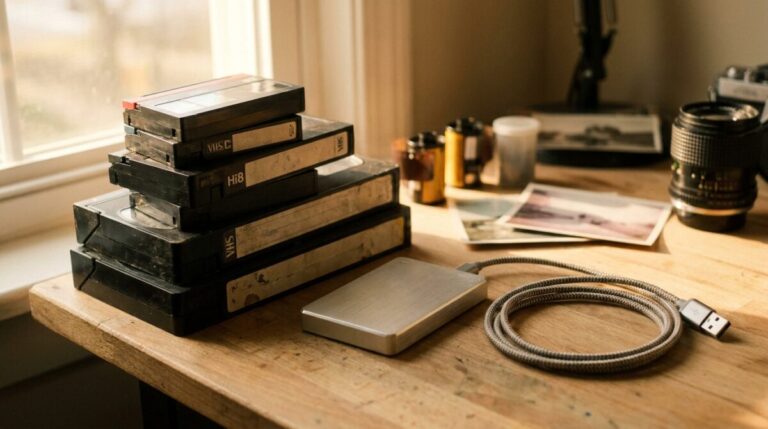
- Format coverage. Nearly any consumer tape can be handled: VHS, Super VHS, Compact VHS (VHS-C), 8mm, Hi8, Digital 8, MiniDV, DV, DVCAM, and even Micro MV (for those, we would need to borrow your working Micro MV camera).
- Pay for what you have. Rather than buying a prepaid box that may hold more tapes than you own, you pay per tape. Blank tapes and tapes that turn out to be recorded TV get skipped, so you only pay for real family footage. How a provider defines that unit is the detail worth checking when comparing VHS to digital services, since a tape longer than two hours often counts as more than one.
- Running time. Most video tapes have a maximum playing time capacity of 2 hours. Tapes that run longer carry an additional charge.
- Homemade only. Copyrighted material and commercially produced programs cannot be converted, even if you recorded them off your own television.
- Minimum order. A $50.00 minimum order applies.
You can see the full format list and ordering details on our video tape to digital transfer page, and if you are comparing providers, our guide to how to choose a VHS to digital service and what it should cost explains per-tape pricing and file sizes. If you are searching for a video tape transfer service near you, it also helps to know which nearby storefronts actually do the work in house and which ones mail your tapes across the country.
How the finished DVDs are organized
A good transfer is not just a two-hour blob of video. Discs are organized with one menu start button for each tape on the disc, and chapter points are set at every 5 minutes, so skipping to the birthday candles or the graduation walk is easy. Discs are not copy protected either, so you are welcome to make as many copies as you like for family members. Just remember that copies you burn at home will be on regular discs, not archival ones, which is exactly why we recommend keeping at least one archival copy as the master and storing a backup at a second location.
DVD, or a drive instead?
DVD is convenient for relatives who still want to drop a disc in a player. But if anyone in the family plans to edit, add music, or cut a highlight reel, ask for editable files on a hard drive or thumb drive as well. Those files work on standard editing software, and be prepared for the size: our files need roughly 5 times more drive space than a typical budget service, because we choose quality over heavy compression. The free estimate calculator will tell you what drive size to expect.
FAQ
Can I convert VHS to DVD without a VCR?
No. A capture device or converter has no tape mechanism inside it. It only digitizes an incoming signal, so something has to play the tape, either a VCR or a VHS-capable camcorder with the right adapter. If you no longer own a working deck, sending the tapes to a service is usually the simpler answer.
How long will my VHS to DVD transfer last on disc?
It depends entirely on the disc. Off-the-shelf discs from a store are said to last 2 to 5 years. Professional long-lasting archival DVDs are tested and rated for over 100 years, and they have been tested against every major DVD maker with far better results. Insist on knowing which kind you are getting.
Are my VHS tapes too old to transfer?
Probably not, but time is not on your side. VHS tapes begin to degrade after about 15 years, so most home videos are well past that point. Tapes in that condition can usually still be played on professional equipment, and the sooner they are captured, the more of the original picture and sound survives.
What kinds of tapes can be converted besides VHS?
Just about any consumer format: VHS, Super VHS, VHS-C, 8mm, Hi8, Digital 8, MiniDV, DV, DVCAM, and Micro MV (that last one requires borrowing your working camera). Mixed boxes of formats are normal and can go in the same order.
Can you transfer tapes I recorded off television?
No. Only homemade footage from your own camera can be converted. Copyrighted material and commercially produced programs are off limits even if you recorded them yourself at home. Tapes that turn out to be TV recordings or blank are simply skipped and not billed.
Can I get files for editing instead of DVDs?
Yes. Tapes can be transferred to editable files delivered on a hard drive or thumb drive that work with standard editing software. Many families order both: archival discs for playback and gifts, files for editing and cloud backup.
A simple next step
You do not have to commit to anything to find out what this would cost. Run your tape count through our free estimate calculator to see pricing and how large a drive you would need, or call toll-free at (888) 405-2685 if you would rather just describe what is in the box and ask questions. Either way, the tapes are safer digitized this year than next.
Reviewed by Scott Foster, Founder of Legacy Digital Productions, Orange, CA - transferring film, tape, slides, photos and audio in-house since 2001 - last updated October 8, 2026.
Sources for this article
- VHS tapes begin to degrade after about 15 years
- Ordinary DVDs are said to last 2 to 5 years; archival DVDs are tested and rated for over 100 years
- Once a disc starts to go bad it becomes unreadable - perfect to nothing in one step
- DIY conversion: A/V-to-USB adapter cable into a USB 2.0 port, RCA composite or S-video cables, real-time transfer with included software
- A converter has no tape mechanism, so a working VCR or VHS-capable camcorder is required
- Formats handled: VHS, Super VHS, VHS-C, 8mm, Hi8, Digital 8, MiniDV, DV, DVCAM, Micro MV (camera needed)
- Most video tapes have a maximum playing time capacity of 2 hours; longer tapes cost more
- Blank or TV-recorded tapes are skipped so you pay only for valuable footage
Facts drawn from this site's own documented knowledge and first-hand experience.