Convert Your Super 8 Film to Digital, Frame by Frame.
The film that made home movies bigger and brighter
Super 8 arrived in 1965 with a larger picture than Regular 8 and quickly became the home-movie standard into the 1980s. We scan it directly, one frame at a time, in true HD or 2K on Motion Picture Academy-grade equipment, never with a projector, and you pay only for the footage we actually transfer. We also convert 8mm film to digital, 16mm film to digital, and Technicolor film to digital.
Get a Free Super 8 QuoteIn-house in Orange, CA since 2001. Over a million reels handled, never one lost.
$0.28/ft
at Gold HD special price (regularly $0.40/ft). HD to 2K.
Since 2001
Hollywood 's Choice
In-House Processing
Expert Technicians
Trusted with the Steven Spielberg documentary reels and Chapman University Film School · All film formats →
See the Super 8 difference.
With Super 8, the transfer method decides how much of the picture and sound you keep. A cheap screen-capture transfer crops every frame and ignores the sound stripe. Our frame-by-frame Super 8 scan keeps the entire image, corrects color as it goes, and pulls the magnetic sound when it is there.




Super 8 Film to Digital: How to Rescue the Home Movies of the ’60s, ’70s, and ’80s
If your family owned a movie camera between 1965 and the mid-1980s, chances are those little yellow boxes and 3-inch reels in the attic are Super 8 film. Birthday cakes with too many candles, road trips in the station wagon, Christmas mornings in shag-carpeted living rooms. Super 8 was the format that recorded an entire generation of American family life.
Those reels are now forty to sixty years old. Every year they sit, the color fades a little more and the film gets a little more fragile. The good news: transferred correctly, Super 8 can look astonishingly good on a modern TV, better than most people ever saw it on a pull-down screen in the den.
After several decades in this industry and millions of feet of film digitized, here’s my complete guide to getting your Super 8 film converted to digital, and getting it done right the first time.
First Things First: Is It Super 8 or Regular 8mm?
Before anything else, it helps to know exactly what you have, because “8mm film” actually covers two different formats, and they require different handling on the scanner.
Kodak launched Super 8 in 1965 as an upgrade to the older regular 8mm (also called Standard 8 or Double 8) format. Both films are eight millimeters wide, but Super 8’s sprocket holes are much smaller, which freed up room for a frame about 50% larger. Bigger frame, more picture detail, and a different perforation pattern that a transfer machine must be set up for.
The quick way to tell them apart: look at the sprocket holes along the edge. Regular 8mm has large rectangular perforations; Super 8’s are small and nearly square. Super 8 also typically came back from the lab on reels with a larger center hub, and the film itself was sold in the famous plastic cartridge rather than on a spool you threaded yourself.
Can’t tell? Don’t worry. Any competent lab will identify each reel during intake. At Legacy Digital Productions we transfer both formats (and 16mm besides), and sorting mixed collections is part of the everyday work.
The DIY Temptation: Those Little Converter Boxes
Search “Super 8 to digital” and you’ll be offered a wall of consumer converter machines, most of them a few hundred dollars. Super 8 is the format these gadgets are primarily built for, so the DIY option is more real here than with any other film gauge. Should you take it?
Here’s what those machines don’t advertise. Most capture at low resolution with tiny, inexpensive sensors, frame alignment drifts, and the exposure is fixed, so dark scenes stay dark and overexposed beach days stay blown out. They have no film-cleaning step, so half a century of dust gets baked into your digital copy. And they pull your brittle, decades-old film through plastic guides with no tension control.
You’ll also spend real time: a 50-foot Super 8 reel runs about three minutes, and a typical family collection of 30, 50, or 100 reels means many long evenings feeding film through a slow machine, once per reel, with no second chances if something jams.
I’ll be direct about where I stand, and about why my opinion carries weight: my company has transferred film for everyone from young families to Hollywood studios, and our work appears in HBO’s documentary Spielberg. The producers brought us Steven Spielberg’s own boyhood reels when only the best transfer would do. Professionally scanned Super 8 and machine-box Super 8 are not the same product. Not even close.
What a Professional Super 8 Transfer Actually Involves
The market is crowded now. Hundreds of companies advertise home movie digitization, up from a few dozen ten years ago, and quality ranges from museum-grade to genuinely destructive. (The worst offenders still project film onto a wall and point a camera at it. Yes, really. In this decade.)
When you’re comparing labs, dig into three areas: how they treat the film before scanning, what their scanners actually do, and what happens to your footage after the scan. Here’s what the answers should look like.
Film Prep: Inspection, Repair, and a Proper Cleaning
Every reel should be inspected on arrival and checked for brittleness, warping, mold, and failing splices. Super 8 collections are full of home-made splices where Dad joined three camera reels onto one big reel in 1974, and those old cement and tape joints frequently need redoing before the film can travel through any machine safely.
Then the film must be cleaned and reconditioned. This step separates professionals from hobbyists more than any other. Fifty years of dust, fingerprints, and dried lubricant sit on your film, and a high-resolution scanner will faithfully record every particle of it unless it’s removed with proper film-cleaning chemistry. The cheap solutions some shops use can attack old emulsion; the professional-grade solutions cost several times more and are worth every penny. We know this area particularly well at Legacy Digital: we developed our own film cleaning system, which other transfer labs around the world now buy from us. Our solutions recondition and lubricate the film as they clean, leaving your originals healthier than they arrived.
The Scan: Frame by Frame, in High Resolution, with Gentle Handling
Ask one question first: “Do you scan frame by frame?” Continuous-capture systems record the film while it plays, which introduces speed drift, motion blur, and that jittery, sped-up “old-timey” look people wrongly assume is just how old film is. It isn’t. Super 8 was typically shot at 18 frames per second, and true frame-by-frame scanning, which photographs each frame as an individual still image, lets the lab rebuild playback at exactly the right speed, smooth and natural.
Resolution is the next question. Super 8’s larger frame holds noticeably more detail than regular 8mm, and Kodachrome, the film stock most Super 8 was shot on, resolves beautifully when scanned properly. Look for a lab scanning beyond Full HD 1080, up to 2K. That’s the level we scan at exclusively at Legacy Digital; it’s the top of the industry, and Super 8 deserves it.
Then there’s how the machine touches your film. Modern archival scanners move film with sprocketless, touchless roller transport. Nothing grips those tiny Super 8 perforations, which on old film are often the first thing to tear. And the film should be lit with cold LED illumination, not hot incandescent bulbs that stress fragile acetate. Our scanners use both, on every machine, for every reel.
Don’t Forget Sound Super 8
One more prep-room detail: from 1973 on, Kodak sold Super 8 sound cartridges, which recorded audio onto a magnetic stripe along the film’s edge. If any of your reels have a rust-brown or bronze-colored stripe running down one side, you have sound film. Make sure your lab can capture that magnetic soundtrack in sync during the scan. Voices from fifty years ago are worth even more than the pictures.
After the Scan: Where Good Transfers Become Great Ones
Most transfer companies hand you the raw scanner output and call it finished. The best labs treat the scan as a starting point. Two post-scan processes make the difference you’ll actually see on your TV screen.
Color Correction, Scene by Scene
Super 8 color shifts as it ages: Ektachrome reels drift toward red and magenta, underexposed indoor scenes sink into murk, and no two reels fade alike. Scene-by-scene color correction adjusts brightness, contrast, and color balance individually for every scene on every reel, pulling the footage back toward what the camera saw on the day. Because frame-by-frame scanning captured each frame as its own image, these corrections can be applied with real precision.
Grain Reduction That Respects the Film
Super 8 has a distinctive grain that is part of its charm, but age and enlargement onto a 65-inch television can turn charm into noise. Intelligent grain-reduction software smooths the exaggerated grain and pixelated edges while preserving true detail, so the footage looks like film, not static.
At Legacy Digital, scene-by-scene color correction and advanced grain reduction are both included free with our Premium Quality service level. We consider them essential, not extras.
Choosing File Formats for Your Digitized Super 8
When the work is done, you’ll choose how your footage is delivered. A good lab asks what you plan to do with it and formats accordingly; a lesser one hands you whatever compresses smallest. The main options:
MP4 is the format for living. It plays on every phone, TV, tablet, and laptop; it uploads straight to YouTube and Google Photos; it emails and texts without fuss. For most families, MP4 copies are what actually get watched. Its only limit: it’s compressed, so it’s not the ideal source if serious editing lies ahead.
QuickTime MOV with ProRes is the master copy: the near-lossless, every-pixel-preserved format that professional editors and archives use. Files are big (plan on a hard drive), but if your footage is irreplaceable or destined for a documentary project, a ProRes master is the gold standard.
MKV is a flexible open-source container favored by digital archivists, though many TVs and Apple devices won’t play it without extra software. For the technically confident only.
AVI with DivX/Xvid encoding survives for compatibility with older Windows PCs and aging media players. It’s occasionally useful, but rarely the best choice for a new transfer.
A note for anyone planning a family film project: Super 8 footage is a wedding-video and anniversary-montage staple, and if yours is headed into Adobe Premiere, Final Cut Pro, or DaVinci Resolve, request a ProRes or high-bitrate master to cut from. Editing an already-compressed MP4 and exporting it again compresses twice, and quality dies a little each time.
At Legacy Digital, you pick your delivery formats after the scan. And if you’re unsure, tell us what you want to do with the footage and we’ll recommend the right combination.
Where Your Files Should Live: Drives, Discs, and Cloud
Plan for more than one copy from the start. The archivist’s rule of thumb (three copies, two kinds of media, one off-site) is the standard we suggest to every customer.
A USB thumb drive is the workhorse for Super 8 collections: it plugs into smart TVs and computers directly, it’s durable, and typical family collections in MP4 fit easily. An SD card offers the same convenience in a smaller package if your devices have card slots; just label it and back it up, because small things get lost. A hard drive becomes the right primary copy for big collections or ProRes masters; it’s the cheapest storage per gigabyte, with the caveat that every drive eventually fails, so it must never be your only copy. Blu-ray discs deliver full HD to any Blu-ray player and make handsome gifts, though disc players are slowly vanishing from homes. DVDs remain the friendliest option for older relatives, but remember DVD is standard definition: your 2K scan gets down-converted, so a DVD should be a sharing copy, never the master. And cloud storage (Google Drive, Dropbox, and the like) lets scattered family stream everything instantly while doubling as the off-site backup that survives fires, floods, and dead drives.
A combination that serves most families well: thumb drive or hard drive at home, a cloud backup, and a few DVDs or Blu-rays in holiday gift wrap.
Your Originals Come Home Too
A proper transfer ends with your original Super 8 reels packed carefully and shipped back to you alongside the digital copies, fully tracked and insured. They come home inspected, repaired, cleaned, and reconditioned. Digitizing doesn’t replace your film; it protects it. Store the originals cool, dry, and dark, and they’ll keep for decades more as the ultimate backup.
And Then: Movie Night
Somewhere in your collection there’s a three-minute reel nobody has seen since the projector bulb burned out in 1982. Soon it will be on your television: steady, color-corrected, at the right speed, maybe even with sound.
Invite everyone. Make popcorn. Watch the room when the faces appear.
About Legacy Digital Productions
Legacy Digital Productions has digitized Super 8, regular 8mm, and 16mm film for families, filmmakers, and studios across North America since 2001. We use the same equipment and processes trusted by the Academy of Motion Pictures in Hollywood (MPAA), the USC School of Cinematic Arts, and the UCLA School of Theater, Film, and Television.
Simple, honest Super 8 pricing. Pay only for the Super 8 film we convert.
No prepaid boxes, and no paying full price for half-full Super 8 reels. Our estimator assumes full reels; blank or unrunnable Super 8 footage is never charged.
A standard Super 8 reel holds 50 feet, about 3 to 4 minutes. Send us silent or magnetic-sound Super 8, and only the film we actually convert is billed.
Choose your quality tier.
Per 50 ft. reel
Gold
Platinum
Pro 2K
Price with current discount
$17.50 $14.00
$27.50 $17.50
$35.00 $22.50
True frame-by-frame, touchless scanning with cold LED light
Film cleaned, reconditioned and lubricated
Compatibility guarantee
Advanced grain reduction
Post-edit to adjust color, saturation, contrast and exposure
Hard-drive delivery is available on every tier; supply your own drive and skip the markup. Super 8 sound film with a magnetic stripe is captured in sync when present.
What happens to your film here.
Clean & recondition
Every reel is cleaned and lubricated with the same solution studios use on archival prints. Never isopropyl alcohol, which dries and damages film over time.
Frame-by-frame scan
Touchless, sprocket-free capture under cold LED light. No hot bulbs, no gears, no projector. Gentle enough that we've run film from 1924.
Scene-by-scene review
A technician adjusts color, contrast and brightness before delivery. We can't always make old film perfect, but we make it look as good as it can.
Returned better than it arrived
Splices repaired as needed. One family's film in the studio area at a time, and no reel ever leaves the building.
The same equipment Hollywood trusts with its history.
We use the same professional scanning equipment and processes trusted by:
That's why editors and executives from CBS, ABC, Universal, Disney Animation, Paramount, Sony, Lightstorm Entertainment and Atlas Entertainment bring us their film, and why more than 20,000 families have trusted us with theirs.
We stand behind every transfer we perform. If you're unhappy with the quality of our work, we'll make every reasonable effort to make it right, at no additional charge. And if another professional service can produce a visibly better transfer from the same originals, we'll match their quality or refund what you paid us for the affected transfer. See Our Full Satisfaction Guarantee →
"The scans were clearer than the originals. Now my kids can see moments I never thought I'd get back."
Dana K.
"Legacy Digital did a fabulous job of getting our old family films and slides digitized for my parents' anniversary. The quality was amazing and my parents were so surprised."
Jennifer L., Long Beach, CA
How it Works
And you’ll have the best quality transfers available at a fair price!
Collect, inventory, pack and drop off or ship your media
We receive your media, prep and clean it, digitize it

You rediscover past memories with family and friends
Frequently Asked Questions
Usually, yes, and often better than expected after color correction. Some film is degraded beyond a perfect image, but we deliver the best result the film can give.
Super 8 has smaller sprocket holes and a larger picture; Regular 8 has bigger holes and a smaller frame. You do not have to know, we identify every reel for you.
Yes. Sound Super 8 carries a magnetic soundtrack that we read in sync as we scan, so your video plays with its original audio. Sound film is 10 cents more per foot.
From $0.28 per foot at the Gold HD special (regularly $0.40). A 3-inch reel holds about 50 feet, or roughly $14. You pay only for the footage we actually transfer.
MP4 files by default (MOV or ProRes on request) on a flash drive or hard drive, and optionally on playable DVD or Blu-ray for $15 per disc. One disc holds about 1,250 feet of film. Your original reels always come home too.
Yes, a $50 order minimum, not counting drives.
On audio, billing is by the hour of sound we actually recover, and blank tape is never charged, so hourly work and any reel minimum simply count toward the order minimum together.
With the current discount, transfers start at $0.28 per foot ($14.00 per standard 50 ft. reel) on the Gold tier. Sound film adds $2.00 per reel. Larger reels are simply more feet: a 200 ft. reel counts as four standard reels, a 400 ft. reel as eight. Use the online estimator for a down-to-the-penny quote; it assumes full reels, so most clients pay slightly less than their estimate.
The main reason you want to put your family memories on DVD is that DVDs last forever right? WRONG!! All DVDs have a shelf life and do fail eventually. And, once a disk starts to go bad, it becomes unreadable. So, instead of the picture fading or degrading a little at a time, you go from perfect to nothing in one step.
Most services like ours use regular disks. They are said to last 2 to 5 years. We don’t think that is acceptable so we use the top of the line long lasting archival DVDs available. These disks are superior for two reasons: First, the construction of the disk is much more durable. It can take punishment and age better than any other disk. Second, the recording layer is built to a true archival standard.
This archival layer holds information far better than the dyes and metals used in ordinary disks. The result, a disk that is thoroughly tested and rated for a shelf life of over 100 years. These discs have been tested against every major maker of DVDs. They stand out as far superior in every case. That’s why we insist on using them, and that’s why you should insist on getting them.
Why doesn’t our competition use them?
Because they are many times more expensive than any other disk. When you want your data to outlast your grandchildren, insist on the best long lasting archival DVDs on the market. And to play it safe, we recommend that you order a backup copy to keep at a second location just in case. (Blu-ray discs are not made to the same archival standard, but we do use the highest rated Blu-ray discs available. Again, backup copies are highly recommended.)
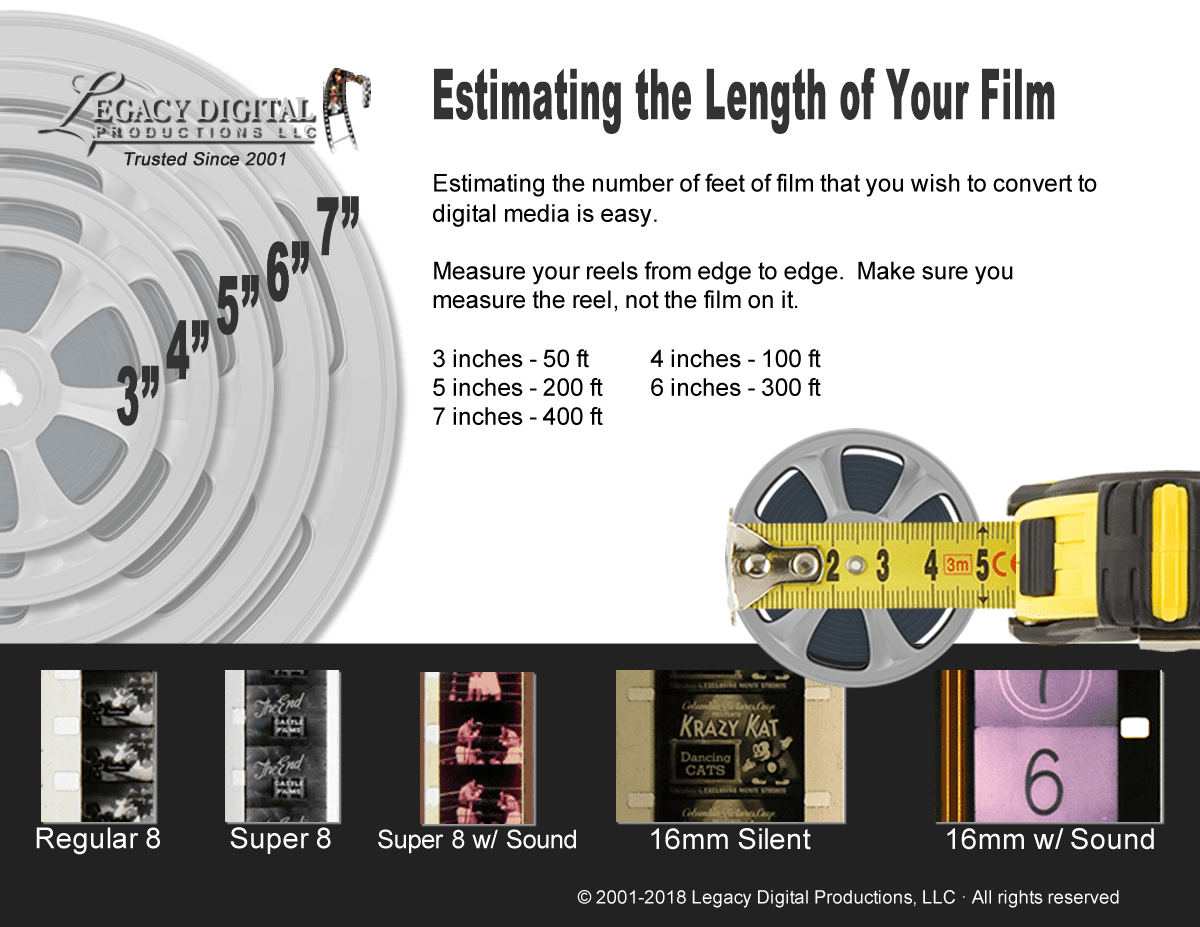
Regular 8 and super 8 mainly differ by the type of reel they are on. The center hole on a regular 8 reel is too small to fit a pencil through. On Super 8 film, the center hole is almost as large as a dime. If your Super 8 has sound, it will have chocolate brown stripes along one or both edges of the film.
8mm film of any type has holes on only one side and is skinnier than your finger.
16mm film is about as wide as a man’s index finger. If it has holes on both sides (make sure you check the actual film, not the white leader) it is silent film. If it has holes on only one side, it is sound film. 16mm film can come on reels as large as 1600 ft (about the size of a giant pizza).
The result you will get from your film transfer can vary greatly depending on the type of process you use. At the bottom of the list are services that will run your film on a projector and videotape the screen for you. This would represent the poorest quality process. This would be about a 2 on a 1 – 10 scale for quality.
The next step up would rate at about a 5 to 6 on the scale. This process is commonly called a telecine transfer. This machine looks like a projector, but instead of having a lense, it has a video chip that captures the image from the film. This yields OK results, but the original resolution is one fourth of what a dvd is capable of, and if you capture the film that way, you cannot take advantage of the full quality a dvd is capable of showing.
Our process would rate a 9.5 on the scale. The only way to get a better quality picture is to go to the high end Hollywood type transfer houses that usually do work for the studios. They can charge 10 to 15 times more than our prices and are certainly out of reach for family budgets.
When we transfer your film to dvds, we take the time to do it right. First we clean and recondition your film. We use the same film cleaner and process that motion picture studios use on their archival footage and master prints. (Watch out for the guys who use isopropyl alcohol. It is a drying agent and will damage your film in time. This saves them about $60.00 per quart, but the person who pays the price is you.)
We then scan your film frame by frame directly to lossless computer files. This frame by frame capture gives you superior results, it is much safer than other methods, and has much better color, contrast, and clarity. Frame captures are done by a high definition 1080p optics system that will trump other telecine systems every time. Frame scans are also natively high definition, 1080p resolution so there is no attempt to upscale inferior footage.
Before we burn your files to disk, we take the time to go through the footage and adjust color, contrast and brightness to enhance the picture quality even further. We can’t always make old film perfect, but we can make it look as good as possible.
We use only the best professional, long lasting archival DVDs for top of the line performance and longevity (Blu-ray discs are not made to the same archival standard, but we do use the highest rated discs available). These top of the line disks are tested and rated for an over 100 year shelf life. Don’t believe everything you hear about dvds lasting forever, the disks you use make all the difference. These disks are the longest lasting media of any kind. They also cost us about 10 times more than other disks.
That’s why most people don’t use them, but again, the person who pays is you. Our disks are also NOT copy protected. You are welcome to make copies of your product all you want. I recommend at least one backup copy on the long lasting archival DVDs, but you will not have to wonder if I am still in business 5 or 10 years in the future if you want another copy. You will be able to do it yourself.
How Legacy Digital compares on film quality
The mail-in box services (Legacybox, Southtree, Kodak Digitizing) and the big-box stores digitize film at 480p standard definition, one-to-one, with no color correction. Legacy Digital scans at Full HD 1080p or 2K (higher than the film itself), with scene-by-scene color restoration, on studio-grade equipment (the type developed for the Academy of Motion Pictures). That is why Hollywood studios and executives, Netflix productions, and universities choose us.
| Film quality | Mail-in and big-box services | Legacy Digital |
|---|---|---|
| Scan resolution | 480p SD (their published spec) | Full HD 1080p or 2K |
| Color and restoration | One-to-one, none | Scene-by-scene color restoration + grain reduction |
| Who does it | Mailed to a bulk facility | In-house since 2001, studio-grade scanners, never lost an item |
Compare us directly: Legacy Digital vs Legacybox, Southtree vs Legacybox, Kodak Digitizing vs Legacybox, or see how we compare to every major service.
8mm Film Transfer. Capture All of It.
Get a free, itemized quote. We measure every reel, tell you the exact cost, and your originals always come home.
Get My Free 8mm QuoteOr call (888) 405-2685 · Orange, CA · In-house since 2001